
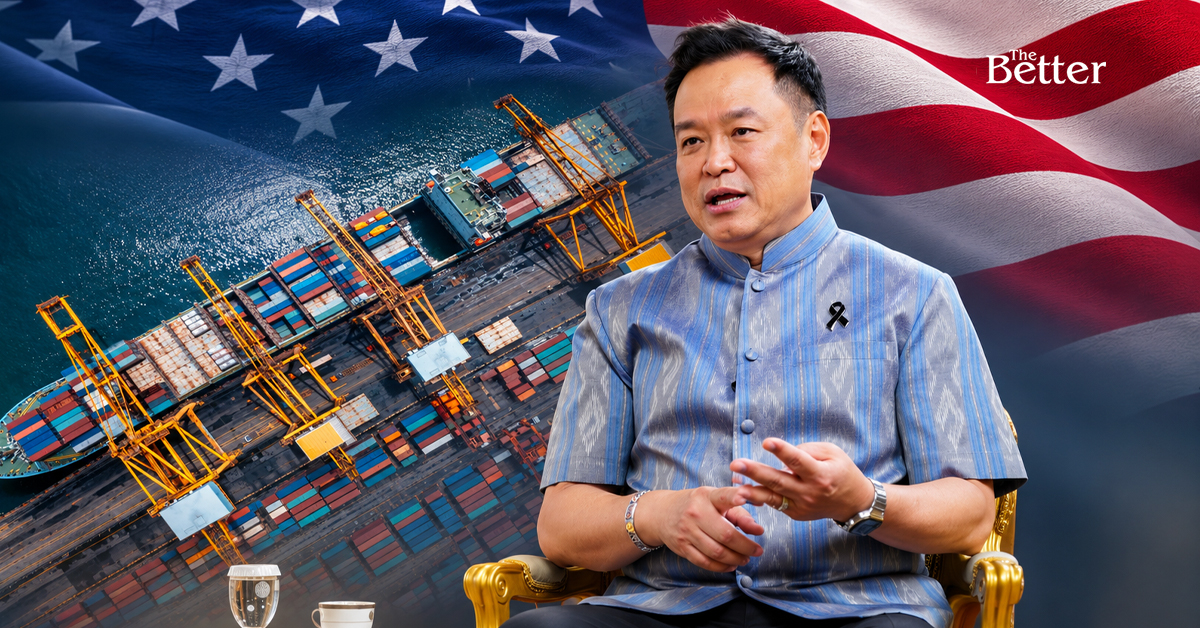
Thai Prime Minister Anutin Charnvirakul has revealed details of trade negotiations with the United States that resulted in an proposed tariff ceiling of 18%, saying he personally handed President Donald Trump a handwritten note requesting additional exemptions for key Thai products, including jasmine rice and corn.
Speaking on his “Talk with Prime Minister Anutin” program on Nov. 28, 2026, Anutin said Thailand had initially expected tariffs of around 19% to 20% before negotiations resulted in a rate capped at 18%. He said the outcome was important for maintaining investor confidence, production planning and the ability of Thai businesses to compete in the U.S. market.
The 18% tariff proposal followed the signing of a joint statement between Thailand and the United States. The full text of the Agreement on Reciprocal Trade (ART) is still being drafted by legal teams. Anutin said the Office of the U.S. Trade Representative (USTR) had informed Thailand of its cooperation during negotiations and efforts to reach key agreements.
Anutin recounted that during the APEC meeting, Deputy Prime Minister and Commerce Minister Suphajee Suthumpun asked him to write directly to Trump seeking further tariff exemptions for important Thai products. He said he wrote a note beginning “Dear Mr. President,” asking Trump to consider exemptions for jasmine rice and corn, among other products.
“I wrote a note by hand on a piece of paper, starting with ‘Dear Mr. President,’ asking him to look into additional exemptions for important products, such as jasmine rice and corn, and then handed it to him,” Anutin said.
He said he told Trump that he did not need to read the note immediately and could simply pass it on to U.S. trade representatives. But Trump reportedly read it for some time before placing it in his suit pocket. After the meeting, Anutin said he approached USTR representatives standing behind Trump and asked them to follow up on the request.
Addressing criticism that his government had withheld details of the trade negotiations, Anutin said trade agreements involved extensive details and negotiations between two parties, with neither side able to dictate terms unilaterally. He defended the Thai negotiating team, saying it had worked to the best of its ability to advance the talks.
“What could I possibly be hiding? I don't know who could hide things from whom or who could deceive whom. Everyone has reached this point. Nobody is smarter or less intelligent than anyone else. It comes down to where each side is willing to compromise. Team Thailand has done everything within its ability,” Anutin said.
The prime minister said the trade negotiations had also prompted greater interest from other countries in pursuing trade agreements with Thailand. The United Kingdom has begun negotiations, while Thailand is continuing discussions with partners at bilateral, regional and other levels. He noted that trade agreements often take years to conclude, citing the deal with Peru, which took about five to six years.
Thailand is also hoping to conclude negotiations on a free trade agreement with the European Union by 2027, Anutin said. The agreement could expand market access for Thai businesses and Thai-owned enterprises operating in Europe, including department stores, food businesses, paper companies, power plants and restaurants. It could also allow them to source more raw materials, components and packaging from Thailand, where some products currently face tariffs of around 20%.
On Thailand's bid to join the Organization for Economic Cooperation and Development (OECD), Anutin said the country had passed its initial assessment but still had 24 steps to complete. Some could be undertaken simultaneously rather than sequentially, he said.
Anutin said the OECD secretary-general had expressed positive views about Thailand's progress, compliance with standards and cooperation, while praising civil servants for preparing information and advancing the membership process alongside the government.
He stressed, however, that the goal should not simply be to secure OECD membership but to improve national standards immediately, including transparency, accountability, non-discrimination in trade and the elimination of forced labor, rather than waiting until Thailand becomes a member.
Asked about corruption, Anutin said scrutiny from the public, independent agencies, courts and the justice system had intensified, requiring officials and those in positions of authority to exercise greater caution and ensure transparency. He said maintaining Thailand's standards and credibility was an ongoing responsibility.
The Better News English