
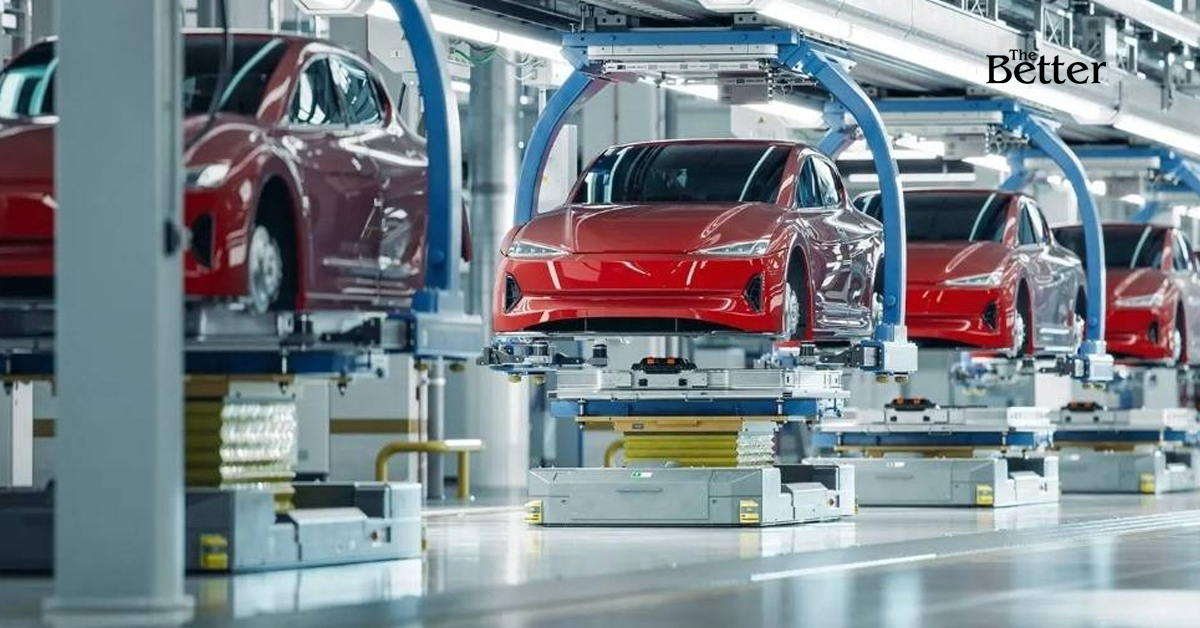
Thailand's automotive industry is entering a defining transition as Japanese incumbents face mounting competition from Chinese electric-vehicle manufacturers. Fresh investment pledges and government assurances suggest that the country's manufacturing base remains firmly in play. But retaining its status as Southeast Asia's automotive powerhouse will require more than persuading automakers to stay: Thailand must secure a meaningful place in the next generation of the global automotive supply chain.
BANGKOK, Nov. 23, 2026 — Thailand is seeking to reassure the world's leading automakers that it remains a reliable manufacturing and export base at a time when the global automotive industry is undergoing one of its most consequential transformations in decades.
The message from Prime Minister Anutin Charnvirakul's Nov. 23 meeting with executives from major Japanese and Chinese automakers was unequivocal: Thailand wants to accommodate multiple automotive technologies, preserve existing industrial capacity and attract investment in next-generation vehicles rather than allow the transition to electric mobility to undermine its established manufacturing ecosystem.
The meeting brought together representatives of Great Wall Motor, BYD and its Rêver Group, Toyota, Mitsubishi Motors, Tri Petch Isuzu Sales and Isuzu Motors Thailand. Anutin said the automotive industry remained a cornerstone of the Thai economy, supporting approximately 750,000 skilled jobs and helping establish the country as the world's 11th-largest vehicle producer, Asia's fifth-largest and the biggest in Southeast Asia.
The immediate investment signals are encouraging. Thailand's Board of Investment (BOI) said six Japanese automakers — Toyota, Honda, Isuzu, Mitsubishi Motors, Mazda and Nissan — had reaffirmed investment plans worth more than 134 billion baht over five years, from 2026 to 2030.
The commitments cover electric vehicles, hybrid technology, biofuels, automation and domestic production of critical automotive components. Separately, the government said Japanese and Chinese manufacturers had reaffirmed their intention to maintain and expand operations in Thailand, using the country as a production and export base.
These pledges offer a degree of reassurance. But they should not be mistaken for proof that Thailand's automotive supremacy is guaranteed.
The Japanese foundation and the Chinese challenge
For decades, Thailand's automotive success has rested on its close industrial partnership with Japan. Toyota, Honda, Isuzu, Mitsubishi, Mazda and Nissan have built extensive manufacturing networks, supported by generations of Thai suppliers, engineers and skilled workers.
That industrial ecosystem remains one of Thailand's greatest competitive advantages. It would be difficult for another Southeast Asian country to replicate the depth of its component-manufacturing network, workforce experience and established export infrastructure overnight.
The emergence of Chinese automakers, however, is changing the industry's competitive landscape. BYD and Great Wall Motor are no longer merely selling imported vehicles into Thailand. They are establishing manufacturing operations and increasingly integrating local suppliers into their production networks.
This presents both an opportunity and a strategic dilemma. Chinese investment can inject capital, technology and competition into the industry, while Japanese manufacturers retain their established production networks and expertise in internal-combustion engines and hybrid vehicles.
The government's decision to pursue a technology-neutral approach — supporting conventional vehicles, hybrids, plug-in hybrids, range-extended electric vehicles and battery-electric vehicles — is therefore economically pragmatic. It avoids placing Thailand's entire industrial future on a single technology before global consumer demand and automotive technologies have fully converged.
Deputy Prime Minister and Finance Minister Ekniti Nitithanprapas said automakers from both countries had reaffirmed their commitment to expanding investment in Thailand. He also said manufacturers welcomed adjustments to excise taxes on imported electric vehicles, which the government believes will create fairer competitive conditions for companies investing in domestic production.
The government's promotion of E20 gasoline and B20 biodiesel also reflects an attempt to preserve the relevance of Thailand's agricultural and biofuel industries alongside the electrification drive.
From vehicle assembly to advanced manufacturing
Perhaps the more important development is Thailand's effort to broaden its industrial ambitions beyond automobile assembly.
The BOI's recent investment mission to Japan has sought to establish a new economic partnership built around automotive technology, semiconductors, artificial intelligence and clean energy.
The proposed semiconductor cooperation is particularly significant. Thailand wants to move beyond conventional electronics manufacturing into photonics, power semiconductors and sensor technologies — components increasingly important to electric vehicles, autonomous driving and advanced industrial systems.
This is a critical strategic direction. The automotive industry is no longer defined principally by engines, transmissions and mechanical components. Its competitive foundations increasingly lie in batteries, power electronics, software, sensors, computing systems and artificial intelligence.
If Thailand remains primarily an assembly destination while the intellectual property, engineering capabilities and high-value components are developed elsewhere, its position in the global automotive industry could gradually weaken.
The BOI's ambition to move from Made in Thailand to Made with Thailand is therefore more than a branding exercise. It reflects the need to embed Thai companies more deeply in international production networks through technology transfers, research partnerships, workforce development and higher-value domestic manufacturing.
Nevertheless, investment announcements are not equivalent to completed factories, technological breakthroughs or sustainable employment. The government will have to ensure that the commitments translate into tangible projects and that Thai small and medium-sized enterprises can participate in the resulting supply chains.
A new Detroit, or an increasingly vulnerable assembly base?
Thailand can still maintain its position as the Detroit of Asia, but the meaning of that title must evolve.
Detroit's historic dominance was built on an integrated automotive ecosystem encompassing manufacturers, suppliers, engineering expertise and industrial innovation. Thailand has established much of the manufacturing foundation, but it must now demonstrate that it can sustain this ecosystem through a technological revolution.
The commitments by six Japanese automakers to invest more than 134 billion baht over five years, alongside continued expansion by Chinese manufacturers, suggest that Thailand has not lost its industrial appeal. Its established supplier networks, strategic location and manufacturing experience remain formidable advantages.
Yet the real contest is no longer simply about which country can assemble the most vehicles. It is about who controls the technologies, components, intellectual property and supply chains that will define the next generation of mobility.
Thailand's greatest opportunity lies in turning Japanese industrial expertise and Chinese technological investment into a stronger domestic manufacturing ecosystem, while ensuring that Thai companies and workers capture a larger share of the resulting value.
The country can remain Southeast Asia's automotive powerhouse if it successfully transitions from being a regional production base into a centre for automotive technology, engineering and innovation. Otherwise, it risks preserving the factories and export statistics while gradually surrendering the technological foundations of its industrial leadership.
The Better News English