
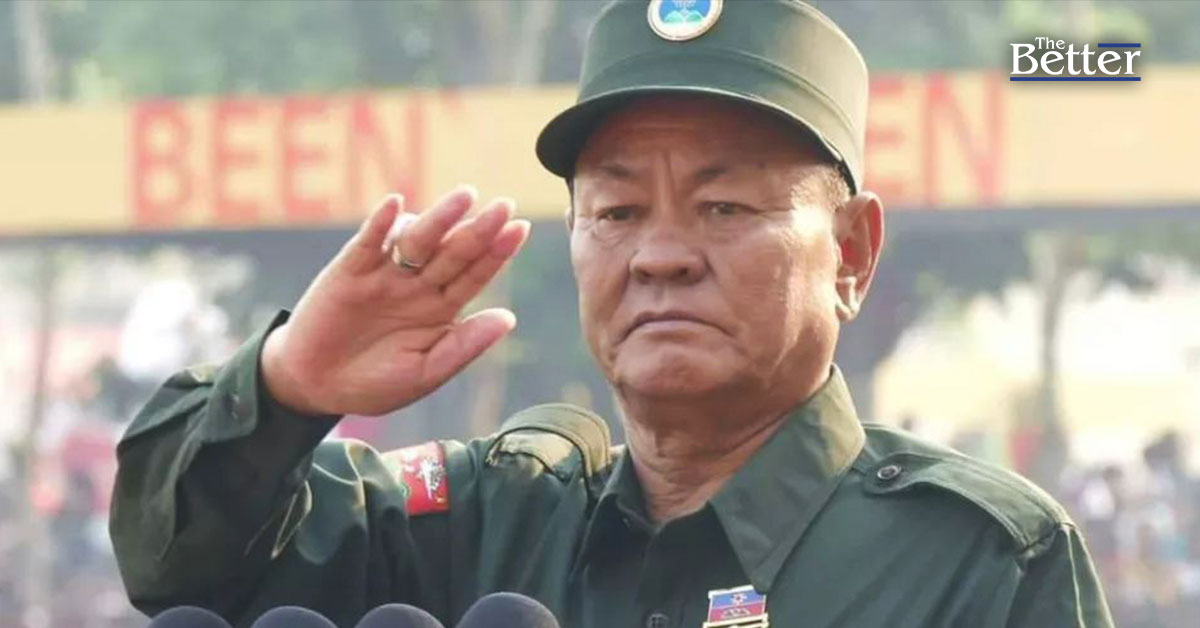
Who Is the Strongman Behind Wa State? The Powerful Figure at the Centre of a Territory Whose Mining Pollution Threatens Thailand’s Rivers
Public interest in the United Wa State Army (UWSA), commonly known as the Wa forces, has surged in Thailand amid mounting concerns over toxic contamination originating from illicit rare-earth mining operations in Myanmar's Wa-controlled territories. Mining activities in southern Wa State have reportedly released hazardous substances into the Kok and Sai river systems, waterways that cross the border into Thailand and sustain communities along their banks.
Yet whenever environmental concerns or other disputes arise involving Thailand, the Wa leadership has tended to deflect responsibility, arguing that Bangkok should negotiate with Myanmar's military authorities instead, on the grounds that the Myanmar government remains the sovereign owner of the territory.
Such an argument, however, obscures the complicated realities of territorial control in Myanmar. Since the outbreak of the country's civil war, the authority of the central government has been severely eroded, with territory continually changing hands among competing military formations, ethnic armed organisations and anti-junta resistance groups. In practice, no single authority exercises uncontested control over the country's entire territory.
To understand who actually holds power in the areas implicated in these disputes, it is necessary to examine the political and military structure of Wa State—and, above all, the man who has presided over its transformation for decades.
Two Territories, One Wa Power Structure
The Wa-controlled territories comprise two geographically distinct areas: Northern Wa, which borders China, and Southern Wa, which extends towards Thailand's Mae Hong Son and Chiang Mai provinces.
Although commonly referred to as Wa State, the territory operates as a de facto self-governing entity within Myanmar's Shan State. Its political and administrative arrangements are largely autonomous, notwithstanding its formal designation within Myanmar's constitutional framework as part of the Shan State Self-Administered Division.
The Wa political and military establishment is built around two principal institutions: the United Wa State Party (UWSP), which serves as the governing political organisation, and the United Wa State Army (UWSA), its armed wing.
Both are dominated by the same individual: Bao Youxiang (鲍有祥), who holds the party's top leadership position and commands the UWSA. His authority extends across the Wa administration, political apparatus and military establishment, making him the central figure in the territory's decision-making structure.
Bao currently serves as president of the Wa State People's Government, general secretary of the UWSP and commander-in-chief of the UWSA.
Ethnically Wa, Bao is also known by his Chinese name, reflecting the profound cultural, linguistic and economic connections between the Wa territories and neighbouring China's Yunnan Province. Chinese is widely used for communication and commerce, the Chinese yuan is the principal currency, and Chinese nationals and businesses have established a substantial presence in the territory.
These connections have become so extensive that Wa State is frequently perceived as operating within China's broader economic and strategic orbit, although it remains formally part of Myanmar.
From a Rural Upbringing to an Armed Struggle
Bao Youxiang was born on September 19, 1949, into a family of Wa tribal leaders. Some accounts suggest that he was born in Kunming, the capital of China's Yunnan Province.
His early life was otherwise rooted in the rural, mountainous environment of Myanmar's Shan State, where he initially worked as a farmer, living much like other members of the region's ethnic communities.
Even in his youth, however, Bao displayed an unusual fascination with weapons and military affairs. He reportedly enjoyed experimenting with firearms and crossbows and once acquired a makeshift cannon for amusement. The device eventually exploded, but the incident apparently did little to diminish his enthusiasm for weapons.
An anecdote from his childhood offers a glimpse into the motivations that would later shape his political and military career.
On one occasion, Bao reportedly gambled away one of his family's pack mules. When his father discovered what had happened, he subjected him to a severe punishment. Bao subsequently explained that he had gambled in the hope of winning enough money to purchase firearms.
His stated ambition was to acquire weapons to defend his family and village against bandits, armed groups and other forms of oppression.
The circumstances of Bao's formative years were shaped by a turbulent regional political environment. Myanmar descended into civil war almost immediately after gaining independence from Britain in 1948. Across the border, China was emerging from its own protracted civil war between the Kuomintang (KMT), or Chinese Nationalist Party, and the Chinese Communist Party.
The Communist victory in 1949 forced remnants of the KMT forces in Yunnan to retreat into Myanmar, while other elements eventually moved into neighbouring Thailand.
Their presence would have profound consequences for communities along the Myanmar-China frontier, including Bao's family.
The Making of a Guerrilla Commander
In July 1959, the Bao family was reportedly attacked and robbed by a KMT military unit commanded by Qiu Hongzhai. Bao Xingga (鲍兴嘎), Bao Youxiang's father, was repeatedly pursued, forcing the family to flee to China in search of refuge.
They eventually settled in Yanbing village, Cangyuan County, in Yunnan Province. In September of that year, Bao enrolled at Yanbing Primary School, where a local teacher gave him the Chinese name Youxiang (有祥), meaning auspiciousness or good fortune.
In April 1961, the family returned to Kunma, a town in northern Wa territory near the Chinese border. Bao married in 1964, the same year his father died.
Their return to the Wa region, however, did not bring the stability the family might have hoped for. Instead, they found themselves caught in a complex web of ethnic rivalries, armed factionalism and competing political interests. Conditions were deteriorating on both sides of the border, with China's Cultural Revolution intensifying political upheaval while Myanmar's civil war continued to destabilise the country.
By 1966, Bao had become increasingly frustrated with the oppression imposed by radical ethnic armed factions associated with the Kuomintang and led by Qiu Hongzhai. He began organising an underground resistance movement, joined by his cousin Bao Sanban and two fellow villagers, Wei Nimen and Li Liule.
The fledgling movement possessed little in the way of military resources, reportedly having only three firearms and a collection of knives. Vastly outnumbered by its adversaries, Bao opted for a swift, surprise assault designed to neutralise the enemy's numerical advantage.
The operation proved unexpectedly successful, providing the fledgling resistance with momentum and attracting additional recruits.
Bao was just 17 years old, but the episode marked the beginning of his emergence as an influential armed leader.
On July 3, 1967, the Kunma Guerrilla Division was formally established, with Bao appointed deputy commander. His responsibilities centred on organising armed units and overseeing military operations.
In November that year, he led his forces to Xuelin Township in Lancang Lahu Autonomous County, Yunnan Province, for military training. The group returned to its base in Kunma approximately two weeks later.
A decisive shift in Bao's trajectory occurred in September 1969, when the Kunma guerrilla force joined the Communist Party of Burma (CPB), bringing it under the party's command. The unit was subsequently reorganised as People's Army Unit 4043, later redesignated Battalion 4243, with Bao serving as company commander.
The Rise of the Red Wa
Despite its revolutionary credentials, the CPB was heavily dominated by ethnic Burman leadership. Wa recruits and other ethnic minorities consequently faced institutional and ethnic barriers within the organisation.
Under the CPB's command structure, Bao and his followers became known as the Red Wa, distinguishing them from other Wa factions operating in the region.
Nevertheless, Bao steadily consolidated his influence within the party's military and political hierarchy. In July 1985, he was elected an alternate member of the CPB Central Committee, a position that elevated his standing and gave him considerable influence over both military and political affairs.
The decisive rupture came on April 17, 1989, when Bao Youxiang and Zhao Nilai, another prominent Wa figure who would later play a pivotal role in establishing the UWSA, spearheaded an armed uprising against the CPB's leadership.
The rebellion effectively dismantled the party's authority in the region and paved the way for the establishment of the United Wa State Army, with Bao assuming the position of commander-in-chief.
As the CPB rapidly disintegrated, the newly established Wa military organisation emerged as one of the most formidable armed actors in Myanmar's ethnic conflict landscape. Its growing military capabilities and territorial influence soon made it a decisive force in the shifting balance of power across Shan State.
On May 18, 1989, the UWSA reached a ceasefire agreement with the State Law and Order Restoration Council (SLORC), the military junta that had taken power following the 1988 pro-democracy uprising, commonly known as the 8888 Uprising.
Under the subsequent arrangement, the Myanmar authorities designated the Wa-controlled territory as Shan State Special Region No. 2, effectively granting the UWSA considerable autonomy and institutionalising its position as a major power broker within the country's fragmented political landscape.
Bao's political stature expanded accordingly.
In November of that year, he participated in a meeting in the Kokang region involving the UWSA, Kokang alliance forces, Eastern Shan State alliance forces, the New Democratic Army-Kachin and the SPP front.
Following the establishment of the alliance, Bao was appointed its commander-in-chief, further strengthening his position among Myanmar's ethnic armed organisations.
From the Golden Triangle to a De Facto State
During the 1990s, the Wa forces expanded their territorial footprint in southern Shan State, reportedly with the cooperation of the Myanmar military. They seized areas previously controlled by Khun Sa, the notorious drug warlord whose operations had made the Golden Triangle synonymous with the international narcotics trade.
The territorial expansion carried significant economic and strategic implications. By occupying former strongholds of Khun Sa's forces, the UWSA gained influence over an area long associated with opium cultivation, narcotics production and cross-border trafficking.
The Wa subsequently became a major force in the region's illicit narcotics economy.
Between 1999 and 2002, the Wa leadership also orchestrated a massive population relocation programme, transferring approximately 80,000 former opium-growing households from northern Wa territory to the more fertile southern areas. The stated objective was to establish agricultural production and strengthen food security in the newly consolidated territories.
The relocation, however, was reportedly conducted through coercive measures, and thousands of people are believed to have died during the process.
The expansion cemented Bao's control over a strategically important section of the Golden Triangle, bringing the Wa leadership closer to the centre of the regional narcotics economy.
In 2002, the United States government identified the UWSA as a significant actor in the international narcotics trade and designated Bao Youxiang a terrorist. Time magazine also featured him on its cover, portraying him as a major drug kingpin.
Yet the Wa territory under Bao's leadership underwent considerable physical and administrative development. Roads were constructed to connect towns and settlements, while public infrastructure and administrative institutions were gradually expanded.
Much of the territory's economic activity, however, has historically been associated with illicit revenue streams, including narcotics and other grey-market enterprises.
Although the Wa authorities have publicly declared their commitment to eradicating opium cultivation, other forms of narcotics production have persisted. Similarly, while the leadership has periodically cooperated with Chinese authorities in cracking down on cross-border online fraud and other illicit activities, concerns have remained over the extent to which underground businesses and criminal networks continue to operate within its sphere of influence.
These activities have helped sustain an economic and political system in which commercial interests, military power and territorial administration are closely intertwined.
A Master of Political Balancing
Bao's influence has become increasingly consequential as Myanmar's military authorities have struggled to maintain control over the country.
Following the February 2021 military coup, the Wa leadership adopted a more assertive posture towards the junta, although it has largely sought to avoid direct confrontation with the Myanmar military.
Instead, the UWSA has pursued a calculated strategy of supporting or maintaining relationships with smaller anti-junta armed organisations, using its influence over these groups as leverage to deter the Myanmar military from undermining the existing ceasefire arrangements.
The strategy has also provided the Wa leadership with opportunities to extend its influence beyond its traditional strongholds and into areas under the authority of Myanmar's central government.
Such ambitions represent a significant strategic undertaking for Bao, whose political calculations have increasingly extended beyond the immediate interests of Wa-controlled territory.
Nevertheless, the escalation of fighting in northern Shan State in late October and early November 2023 prompted the Wa leadership to adopt a carefully calibrated position of neutrality, calling on the warring parties to exercise restraint and pursue negotiations.
As hostilities intensified between the Myanmar military and anti-junta forces, including the Three Brotherhood Alliance operating in the Kokang region, both sides sought to secure the Wa leadership's support or, at the very least, prevent it from aligning with their adversaries.
Bao's response reflected a longstanding preference for strategic flexibility rather than rigid political alignment.
By maintaining working relationships with competing factions, he has managed to preserve the Wa leadership's autonomy while safeguarding its military and economic interests amid Myanmar's rapidly shifting balance of power.
This political pragmatism has allowed the Wa administration to maintain its position even as the authority of Myanmar's central government has deteriorated. It has also enabled the UWSA to retain considerable influence over neighbouring armed organisations and expand its strategic reach.
Bao's leadership has therefore been characterised by a combination of military strength, political calculation and an ability to exploit the competing interests of Myanmar's rival power centres.
Through this approach, he has transformed Wa State from a remote insurgent stronghold into a highly organised de facto political entity—often described as a modern city-state in the mountains.
Yet the question facing Thailand today is whether the autonomy and military power that Bao has painstakingly consolidated also carry responsibilities beyond the borders of Wa-controlled territory.
As concerns mount over the environmental consequences of rare-earth extraction in Myanmar's borderlands, the issue is no longer confined to the internal power struggles of an ethnic armed organisation. It has become a matter of transboundary environmental security, public health and accountability.
For Thailand, understanding who exercises effective authority over the mining areas is an essential first step towards determining who should be held accountable when pollution crosses the border and threatens the livelihoods of downstream communities.
The Better International News Team