
Bangkok's strategy shifts from attracting Chinese capital to building domestic industrial capabilities, as nearly 500 Chinese investment applications, the ACFTA 3.0 upgrade and the Thai–Chinese high-speed railway signal a deeper economic partnership.
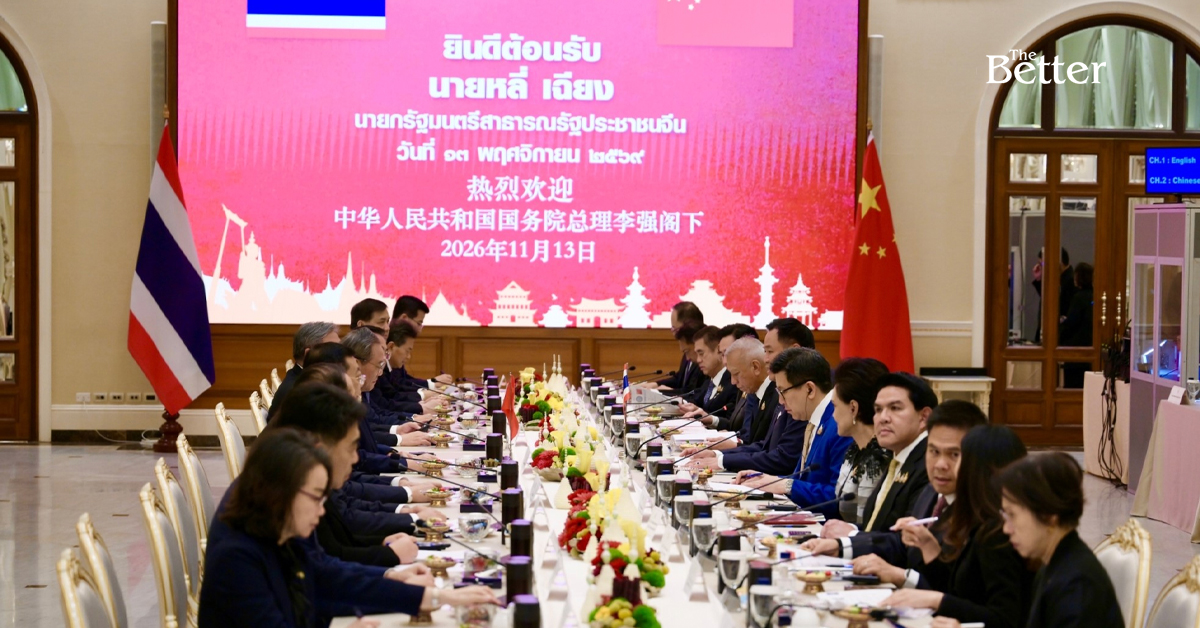
Thailand is seeking to redefine its economic relationship with China, moving beyond its traditional role as a manufacturing base and regional trading partner towards becoming a more integrated centre for advanced manufacturing, technological development and regional connectivity. The latest diplomatic and business engagements between Prime Minister Anutin Charnvirakul and Chinese Premier Li Qiang suggest that Bangkok is increasingly viewing China not merely as a major trading partner, but as a strategic economic partner capable of helping accelerate Thailand's industrial transformation.
The two leaders' discussions, accompanied by a Thailand–China Business Roundtable attended by more than 200 government officials and business executives, have placed industrial investment, free-trade integration, infrastructure development and technology transfer at the centre of bilateral cooperation. The significance of these developments lies not simply in the number of investment projects being announced, but in the Thai government's attempt to convert China's expanding economic presence into a more substantial domestic industrial ecosystem.
From investment attraction to industrial co-creation
One of the most notable indicators of the growing economic relationship is the volume of Chinese investment applications submitted to Thailand's Board of Investment (BOI). According to Anutin, Chinese companies submitted nearly 500 investment applications during the first nine months of 2026, making China the largest source of foreign investment applications and accounting for more than one-third of all foreign investment projects during the period.
The figures demonstrate the continuing attractiveness of Thailand as a manufacturing and investment destination for Chinese enterprises seeking to expand their international operations. However, they also raise a more important policy question: how can Thailand ensure that the influx of Chinese capital generates lasting benefits for its domestic economy rather than simply expanding foreign-owned production capacity?
This is particularly important as Thailand faces mounting structural challenges, including sluggish productivity growth, an ageing population, technological gaps and intensifying competition from neighbouring economies.
Anutin has consequently emphasised the concept of co-creation, under which Chinese investors are expected to work more closely with Thai manufacturers, suppliers, universities and skilled workers. The objective is to encourage investment that generates employment, incorporates locally sourced materials and components, transfers technology and develops the capabilities of Thai enterprises.
This represents a potentially important shift in Thailand's investment strategy. Rather than measuring success primarily through investment applications and capital commitments, the government wants to strengthen domestic participation in the production networks established by foreign investors.
The challenge, however, will be ensuring that these commitments translate into measurable improvements in local content, research and development, workforce skills and the competitiveness of Thai small and medium-sized enterprises.
Electric vehicles offer an early test of the new partnership
The electric vehicle industry provides one of the clearest examples of both the opportunities and challenges associated with Thailand's economic partnership with China.
Over the past several years, Chinese automotive manufacturers have increasingly selected Thailand as a production base, attracted by its established automotive supply chain, industrial infrastructure, strategic location and government investment incentives.
The country has sought to capitalise on this development by positioning itself as a regional EV manufacturing hub. Chinese companies have brought capital, manufacturing expertise, battery technologies and access to international supply chains, helping accelerate Thailand's transition from conventional internal-combustion vehicles towards electric mobility.
Nevertheless, attracting automobile assembly operations is only the first stage of industrial transformation.
Thailand's longer-term objective must be to integrate local component manufacturers into the emerging EV supply chain, develop battery-related industries, strengthen engineering capabilities and establish a stronger domestic technological foundation.
The government's emphasis on connecting Chinese EV manufacturers with Thai component producers therefore reflects an attempt to move beyond an investment-led industrial model towards one based on domestic industrial participation.
If successfully implemented, this approach could help preserve Thailand's traditional automotive manufacturing strengths while repositioning the country within the rapidly changing global automotive industry.
However, the transition also carries risks. Without sufficient local technological development, Thai manufacturers could become increasingly dependent on foreign-owned production systems, imported components and externally controlled intellectual property.
ACFTA 3.0: A larger economic framework for regional integration
Another major component of the emerging partnership is the acceleration of the upgraded ASEAN–China Free Trade Area, known as ACFTA 3.0.
Anutin has called for the agreement to enter into force as soon as possible, viewing it as an important mechanism for expanding trade, improving market access and strengthening regional economic integration.
The significance of ACFTA 3.0 extends beyond conventional tariff reductions. Its broader framework is intended to address the changing requirements of modern commerce, including digital trade, economic cooperation, supply-chain connectivity and emerging areas of technological development.
For Thailand, the agreement could create opportunities to strengthen its position as a production and distribution centre linking Chinese industries with ASEAN markets.
This is particularly relevant given ASEAN's combined population of approximately 700 million people and its growing importance as a destination for manufacturing investment, consumer markets and regional supply-chain diversification.
Thailand's geographical position at the heart of mainland Southeast Asia gives it an advantage in connecting Chinese production networks with markets in Cambodia, Laos, Myanmar, Vietnam, Malaysia and Singapore.
Nevertheless, deeper trade integration will also intensify competition. Thai manufacturers will face greater pressure from Chinese producers that benefit from economies of scale, technological advantages and highly developed industrial supply chains.
The government will therefore need to ensure that trade liberalisation is accompanied by measures to strengthen domestic productivity, improve industrial standards and enhance the competitiveness of Thai businesses.
The challenge is not simply to increase bilateral trade, but to ensure that Thai enterprises are capable of capturing a larger share of the economic value generated by regional integration.
High-speed railway: Turning Thailand into a regional logistics gateway
Infrastructure connectivity represents another strategic pillar of the expanding relationship.
Thailand has reaffirmed its intention to complete the first phase of the Thai–Chinese high-speed railway and bring it into service by 2030. The project is also expected to support the broader railway connection linking Thailand with Laos and China, eventually strengthening transport connections across mainland Southeast Asia.
The strategic implications extend well beyond passenger transportation.
A more integrated railway network could improve the movement of agricultural products, industrial goods and manufactured components, while reducing logistics costs and strengthening the commercial links between Thailand, Laos and China's southwestern provinces.
For Thailand, the railway could become an important instrument for developing its role as a regional logistics and distribution hub.
It could also complement the country's broader ambitions to attract investment into the Eastern Economic Corridor and other industrial development zones by improving access to regional markets.
However, the economic benefits will depend on the quality of supporting infrastructure, including freight terminals, customs procedures, multimodal transport facilities and connections with industrial estates and ports.
The railway should therefore be understood as part of a wider regional economic architecture rather than an isolated infrastructure project.
Its commercial viability will ultimately depend on whether Thailand can generate sufficient freight volumes, attract logistics investment and integrate the railway into regional production and distribution networks.
Beyond manufacturing: AI, semiconductors and the clean-energy transition
The discussions between Anutin and Li also demonstrate that bilateral economic cooperation is expanding into industries that will shape the next generation of global economic competitiveness.
Thailand has identified electric vehicles, semiconductors, clean energy, cloud computing, data centres and space technology as priority areas for attracting high-quality investment.
The government has also highlighted artificial intelligence and advanced digital technologies as important foundations for future economic growth.
This ambition is particularly significant as Thailand seeks to diversify its industrial structure beyond traditional sectors such as automobiles, electronics, agriculture and food processing.
Chinese companies could contribute capital, manufacturing expertise, technological capabilities and access to extensive supply chains in these emerging industries.
Meanwhile, Thailand offers a strategic location within ASEAN, an established industrial base and opportunities for companies seeking to expand their production and commercial networks across Southeast Asia.
Energy security will also become increasingly important. The expansion of semiconductor facilities, data centres and advanced manufacturing operations will require reliable electricity supplies, competitive energy costs and a larger share of clean energy.
Consequently, cooperation in renewable energy and green industries could become an important determinant of whether Thailand can attract the next generation of technology investment.
However, the country's ability to compete will depend on more than investment incentives. Regulatory certainty, electricity infrastructure, water availability, skilled labour and technological capabilities will all influence investment decisions.
Thailand Fast Pass and Super License: Addressing the domestic investment bottleneck
Recognising that investment competitiveness depends partly on the speed and predictability of government procedures, Anutin has highlighted the Thailand Fast Pass initiative and the proposed Super License legislation as instruments for removing administrative obstacles.
The Thailand Fast Pass mechanism, involving the BOI, is intended to coordinate major investment projects and accelerate the resolution of regulatory and procedural difficulties.
The proposed Super License framework similarly reflects the government's intention to simplify the licensing environment and enable qualified investment projects to begin operations more quickly.
These measures address a longstanding weakness in Thailand's investment environment: the gap between announcing investment commitments and translating them into actual projects.
For international investors, delays involving permits, land development, utilities, environmental approvals and inter-agency coordination can significantly increase project costs.
Streamlining these procedures could therefore improve Thailand's competitiveness against other ASEAN investment destinations.
Nevertheless, faster approvals must not come at the expense of transparency, environmental safeguards or fair competition. The government's ability to combine administrative efficiency with effective regulation will be essential to maintaining investor confidence.
Agriculture and food security: A complementary economic opportunity
While advanced manufacturing and digital industries dominate much of the discussion, agriculture and food processing remain important areas of bilateral cooperation.
Thailand possesses substantial agricultural resources, established food-processing industries and products with strong consumer recognition in China.
China, meanwhile, offers advanced food-processing technologies, logistics capabilities, distribution networks and access to a vast consumer market.
Anutin has therefore proposed closer cooperation to increase the value of agricultural production through technology, processing and expanded market access.
The discussions also included the progress of a proposed purchase of 500,000 tonnes of Thai rice by China, with the first shipment of 40,000 tonnes already sold.
Beyond the immediate commercial value, this arrangement could help support agricultural exports and generate income for Thai farmers.
The two sides also discussed accelerating the registration of Thai geographical indication (GI) products in China and expanding distribution opportunities for Thai small and medium-sized enterprises through Chinese e-commerce platforms.
This is important because Thailand's agricultural competitiveness increasingly depends on its ability to move beyond exporting raw commodities towards higher-value products, differentiated food brands and technology-intensive processing.
Closer cooperation with China could provide opportunities to achieve this transition, although Thailand will need to maintain strong quality standards, product traceability and bargaining power within the supply chain.
The strategic balancing act: Partnership without excessive dependence
Despite the economic opportunities, the expanding relationship with China also presents Thailand with a complex strategic balancing act.
China is already a major economic force in Thailand, particularly in automotive manufacturing, electronics, digital infrastructure and consumer markets. Its growing investment presence could accelerate industrial upgrading, but it could also create new dependencies if domestic enterprises fail to develop sufficient technological and commercial capabilities.
The Thai government has therefore emphasised the need for transparent and fair business practices, including stronger action against illegal business operations and the use of Thai nominee shareholders to circumvent restrictions on foreign business ownership.
This issue is particularly important as the government seeks to attract legitimate foreign investment while protecting domestic businesses from unfair competition.
Thailand must also maintain its economic openness to other international partners. Its long-standing industrial relationships with Japan, the United States, Europe and other Asian economies remain important to the country's export competitiveness and technological development.
The objective should not be to replace one economic partner with another, but to maximise the benefits of international investment while maintaining strategic flexibility.
The broader cooperation agenda also extends beyond economic affairs. Thailand and China have discussed collaboration on transnational crime, online scam networks, cybersecurity, energy security and environmental challenges in the Mekong subregion.
Such cooperation reinforces the recognition that economic connectivity and regional security are increasingly interconnected.
From diplomatic goodwill to measurable economic transformation
The latest engagement between Anutin and Li represents an important opportunity to elevate Thailand–China relations into a more comprehensive economic partnership.
The nearly 500 Chinese investment applications submitted during the first nine months of 2026, the push to accelerate ACFTA 3.0, the 2030 high-speed railway target and the expansion of cooperation into advanced industries collectively indicate that the relationship is entering a more ambitious phase.
Yet the ultimate measure of success will not be the number of diplomatic agreements, investment applications or business forums.
It will be whether Thailand can use this partnership to strengthen its domestic industrial capabilities, increase productivity, develop skilled workers, generate higher-value exports and create opportunities for Thai businesses to participate in global supply chains.
For Anutin's government, the immediate task is to turn investment momentum into tangible economic outcomes.
China can provide capital, technology, industrial expertise and access to markets. Thailand, in turn, must provide a competitive investment environment, capable domestic enterprises, skilled human resources and a clear long-term development strategy.
The emerging partnership therefore presents Thailand with both an opportunity and a test: whether it can transform its position from a destination for foreign manufacturing investment into a country that actively participates in designing, developing and capturing the value of the industries of the future.
Ultimately, the success of Thailand's economic relationship with China will depend not on how much Chinese investment enters the country, but on how much stronger the Thai economy becomes as a result.
The Better News English