
Thailand is seeking to deepen its partnership with Airbus beyond conventional aviation investment, with the government pushing for greater technology transfer, workforce development and cooperation in emerging industries such as space technology and clean energy.
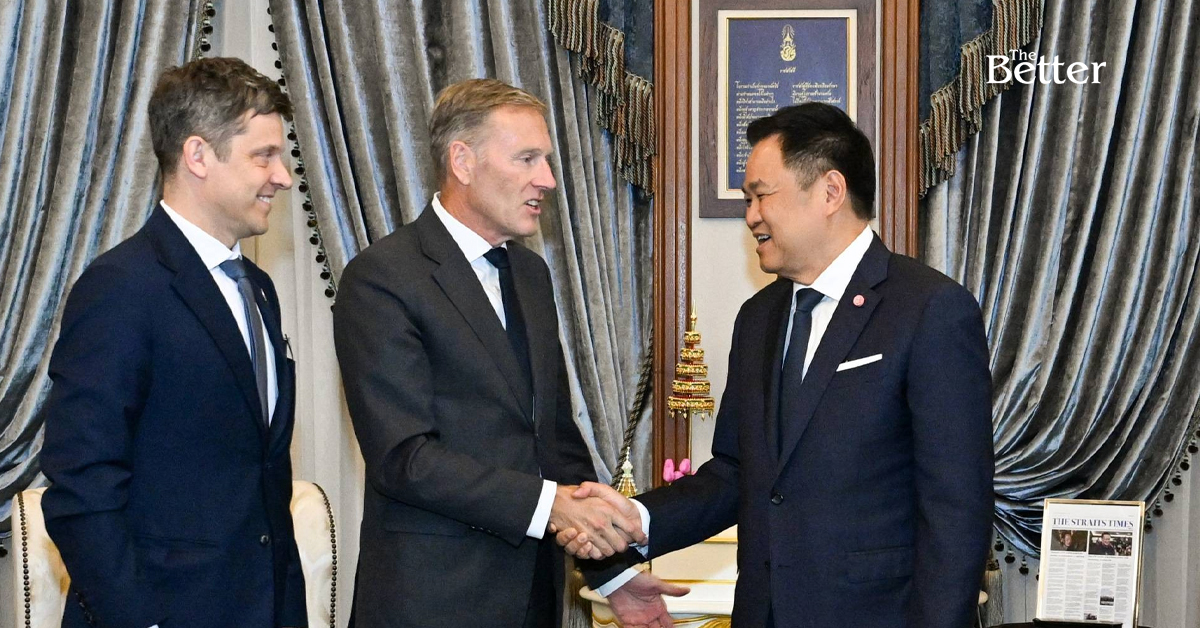
Recently, Anutin Charnvirakul, Deputy Prime Minister and Minister of Interior, met with Wouter van Wersch, Executive Vice President for International Affairs at Airbus, and Bert Porteman, Airbus’s representative in Thailand, to discuss ways to expand cooperation across aviation, space technology, workforce development and clean energy.
The discussions reflect Thailand’s broader ambition to move beyond being a market for global aerospace companies and become a more integrated part of their international production, technology and knowledge networks.
Anutin reaffirmed the government’s policy of promoting aviation and other “industries of the future”, while commending Airbus for its continued cooperation with Thailand, particularly in employment creation, workforce development and the expansion of the country’s aviation industry.
He urged Airbus to consider broadening its partnership with Thailand and adapting successful cooperation models implemented in other countries to the Thai market. Such an approach, he argued, could give Thailand greater access to Airbus’s global expertise, technology and international networks.
The emphasis on technology and knowledge transfer is particularly significant. For Thailand, attracting investment alone may not be sufficient to move the country further up the aerospace value chain. The government is increasingly seeking partnerships that can create skilled employment, develop domestic capabilities and enable Thai companies and personnel to participate in higher-value activities.
One of the key proposals discussed was Airbus’s plan to establish a Center of Excellence in Thailand, which could become a hub for developing knowledge, technology and human capital.
The proposed center would connect Airbus’s global expertise and technological capabilities with Thailand, giving Thai personnel opportunities to acquire advanced skills and experience. Over the longer term, such a facility could help strengthen Thailand’s industrial capabilities and create a larger pool of highly skilled workers for the aviation and aerospace sectors.
This is important as Thailand seeks to establish itself as a regional aviation hub. The country’s ability to compete for aerospace investment will increasingly depend not only on infrastructure and location, but also on the availability of engineers, technicians, digital specialists and other highly skilled personnel.
Clean energy was another area where the government is seeking deeper cooperation. Anutin proposed that Airbus consider supporting the development and use of Sustainable Aviation Fuel (SAF) produced in Thailand, using locally sourced agricultural raw materials.
The proposal links Thailand’s aviation ambitions with its agricultural economy. Developing a domestic SAF supply chain could help reduce greenhouse gas emissions from aviation while creating new markets for agricultural products and generating additional income for Thai farmers.
For Thailand, SAF could therefore become more than an environmental initiative. If developed at sufficient scale, it could create a new industrial ecosystem connecting agriculture, energy, aviation and advanced technology.
The challenge, however, will be to develop a commercially viable supply chain that can provide sufficient quantities of SAF while meeting international sustainability standards and remaining competitive in the global aviation market.
Thailand is also looking to expand its relationship with Airbus beyond commercial aviation and into space technology and security. Anutin proposed deeper cooperation based on Airbus’s existing relationships with Thai organisations including the Geo-Informatics and Space Technology Development Agency (GISTDA) and Thaicom Public Company Limited.
The focus would include knowledge and technology transfer as well as workforce development, allowing Thailand to strengthen its capabilities in satellite technology, space-related applications and other emerging areas.
This could potentially give Thailand a broader role in the regional space economy. Rather than relying primarily on foreign technology and services, the government wants international partnerships to help build domestic expertise and technological capabilities.
The discussions also covered the development of Thailand’s aviation industry and related services, including cooperation with Thai Airways International Public Company Limited, as well as the development of the aviation workforce.
These efforts are closely linked to the government’s ambition to position Thailand as a regional aviation hub.
Thailand already benefits from its geographic position at the centre of Southeast Asia and from major aviation infrastructure. But becoming a genuine regional hub requires more than passenger traffic and airport capacity. It also requires a competitive ecosystem covering aircraft maintenance, repair and overhaul, aviation services, training, logistics, engineering and related high-value industries.
Airbus’s involvement could potentially strengthen several of these areas if cooperation expands from aircraft sales and existing industrial partnerships into training, engineering, technology development and local supply chains.
The broader significance of the Airbus talks is therefore not simply whether the company will increase its investment in Thailand. The more important question is whether Thailand can use its relationship with one of the world’s leading aerospace companies to build lasting domestic capabilities.
The government is clearly seeking a partnership model in which foreign investment is accompanied by job creation, skills development, technology transfer, local supply-chain development and access to global networks.
For Airbus, Thailand offers a growing aviation market, a strategic location in Southeast Asia and the potential to develop regional capabilities in aviation, space and sustainable aviation. As for Thailand, the opportunity is to ensure that Airbus’s presence contributes to the country’s technological upgrading rather than remaining primarily a commercial relationship.
If the proposed Center of Excellence, SAF cooperation and expanded space-technology partnerships move forward, the Airbus-Thailand relationship could evolve into a broader industrial partnership—one that extends well beyond aviation and potentially helps Thailand move further up the aerospace and advanced-technology value chain.
The Better News English