
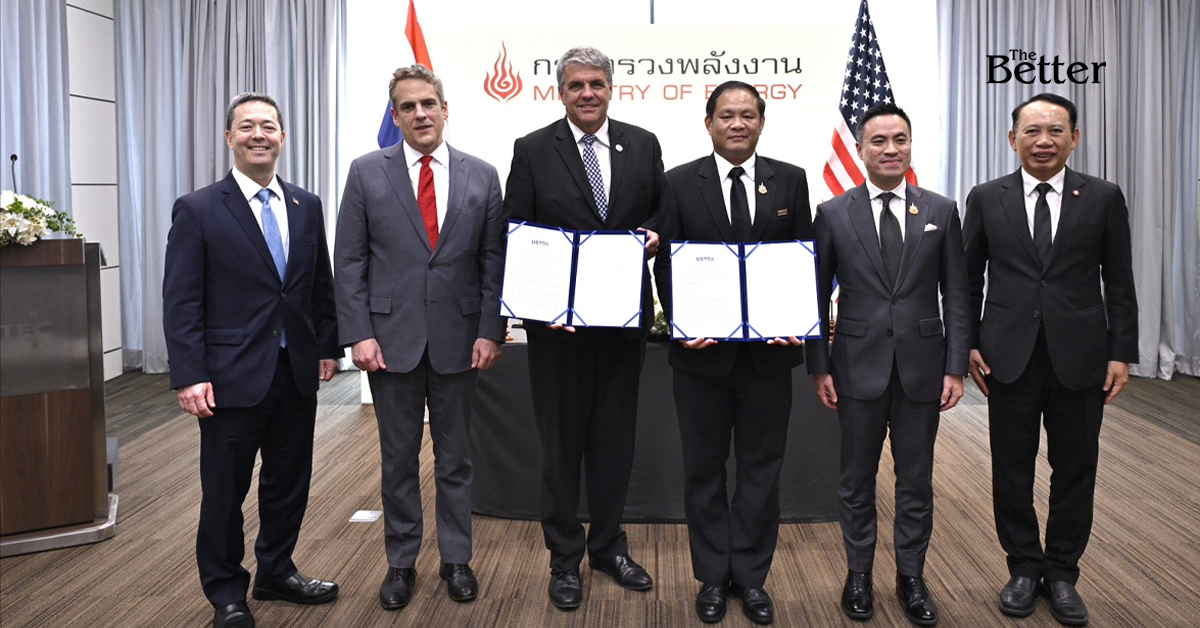
Thailand and the United States have strengthened cooperation on advanced nuclear energy technology with the signing of a grant agreement to conduct a preliminary feasibility study for a Small Modular Reactor (SMR) power plant project in Thailand.
The agreement was signed between the U.S. Trade and Development Agency (USTDA) and the Electricity Generating Authority of Thailand (EGAT) during Gastech 2026 at the Bangkok International Trade & Exhibition Centre (BITEC).
The agreement was signed by Thomas R. Hardy, Acting Director of USTDA, and Narin Phoawanich, Governor of EGAT. The signing was witnessed by Akanat Promphan, Minister of Energy; James Danly, U.S. Deputy Secretary of Energy; Prasert Sinsukprasert, Permanent Secretary for Energy; and Sean K. O'Neill, U.S. Ambassador to Thailand.
Thomas R. Hardy said the partnership reflects the United States' commitment to promoting American innovation and leadership in nuclear energy for peaceful purposes, as well as in advanced nuclear technologies.
He said the collaboration forms part of efforts to revitalize the U.S. nuclear energy sector, ushering in a new era of innovation and investment while creating new opportunities to deploy advanced technologies both in the United States and around the world.
Hardy added that the initiative also aligns with broader U.S. foreign policy objectives by working with trusted partners to expand access to reliable energy technologies and strengthen energy security across the Indo-Pacific region.
Narin Phoawanich said Thailand is at a pivotal point in its transition toward clean energy and must explore a range of options to strengthen energy security, maintain the stability of electricity generation and support the country's carbon neutrality goals.
He said the USTDA support provides an important foundation for Thailand to assess the feasibility of SMR technology. EGAT, he added, values the opportunity to learn from U.S. innovation, expertise and experience and remains committed to strengthening energy cooperation between the two countries.
As Thailand's electricity demand continues to increase, the potential integration of SMR technology into the country's long-term power generation mix could contribute to grid resilience and energy security while supporting economic growth and industrial development.
Under the agreement, EGAT will conduct preliminary assessments covering potential project sites and costs, as well as the regulatory processes and requirements that would be necessary for the future adoption of SMR technology in Thailand.
The feasibility study is expected to provide Thailand with greater information for evaluating SMRs as one potential component of a more secure and diversified long-term energy portfolio.
The Better News English