
King Prasat Thong of Ayutthaya (reigned 1629–1655) had two important sons born to his chief consort: Prince Chai and Prince Narai.
Prince Narai had a unique personality, particularly his fondness for Persian customs. He ate, dressed, and interacted with people like the Persians, and spent much of his time among them.
This is recorded in the book Safine-ye Solaymani (The Ship of King Sulayman), a Persian travelogue documenting the mission sent to the Siamese kingdom of Ayutthaya in 1685 by Suleiman I of Persia (reigned 1666–1694), the Safavid king (Shah) of Iran.
Safine-ye Solaymani states that King Narai “regularly visited the Persians. He appreciated their social manners, table manners, food, and drink.” It adds that “the Persians were very interested in this.”
Persian culture was popular among the Islamic kingdoms of South Asia at the time as a symbol of nobility and elegance. This popularity spread to Ayutthaya, a predominantly Buddhist and Hindu kingdom, and was particularly embraced by King Narai.
Shia Muslims from Persia were already playing a significant role in the politics and trade of Ayutthaya, and it seemed that King Narai’s “pro-Persian” stance would provide them with a valuable political opportunity.
The Persians naturally desired to see the King of Ayutthaya become a Shia Muslim and Ayutthaya transformed into a sultanate. If their dream came true, it would have been a magnificent reward for those who had been exiled from their homeland.
It would also have been a worthwhile gamble because Ayutthaya, which they called “Shahrinav” (“New City”), was one of the wealthiest port cities in the world.
The reasons why the Persians called Ayutthaya “New City” are unclear, but it can be speculated that “Old City” may have referred to some ancient city, such as Dvaravati.
This can perhaps be connected to the traditional official name of Ayutthaya: “Krung Thep Dvaravati Sri Ayutthaya,” or “Krung Deva Dvaravati Sri Ayodhya.”
“Krung Thep” (or Deva) refers to the city of Thep Nakhon (Deva Nagara), the original home of King Uthong of the Chiang Rai dynasty. “Dvaravati,” meanwhile, refers to the wealthy ancient kingdom that flourished in central Thailand from around the sixth century onward. “Sri Ayutthaya” was the new name given during the reign of King Uthong.
Krung Thep Dvaravati Sri Ayutthaya became a port city that attracted people from all over the world, including Iranians, or Persians. It became a city that every fortune seeker wanted to visit or where merchants sought to establish a trading post.
The name “Krung Thep Dvaravati Sri Ayutthaya” became a brand associated with trade and prosperity in the region. Even after Ayutthaya was destroyed by the Burmese, the name “Krung Thep Dvaravati Sri Ayutthaya” was used in connection with the establishment of the new capital in Bangkok, continuing until the reign of King Rama III.
This was because “Krung Thep Dvaravati Sri Ayutthaya” had become a name associated with wealth, political power, and a global center of commerce.
When the son of King Prasat Thong favored Persian culture and associated closely with the Persians, they saw this as a golden opportunity to “invest” in Prince Narai.
But King Narai was not simply a young man indulging in the luxuries of Persia. He also planned to use the Persians for political gain.
That opportunity arose when King Prasat Thong died.
It was common knowledge that the eldest son of the queen consort had a claim to the throne.
That was a very theatrical way of thinking.
Uncles could seize power from nephews, siblings from older siblings, sons from fathers, nobles could assassinate rulers, and commoners could overthrow the nobility.
The politics of Ayutthaya and other Eastern countries were far more turbulent than any play, and few adhered to established rules or even “basic moral standards.”
The struggle for the throne was a normal part of Ayutthaya politics, and this reign was no exception.
Prince Chai had reigned for only nine months when someone plotted to overthrow him.
That person was his half-brother, Prince Narai.
Prince Narai conspired with his uncle, Prince Sri Suthammaracha, to seize power from Prince Chai and then had him executed.
But Prince Narai did not sit on the throne himself. Instead, he handed the throne to Sri Suthammaracha.
Perhaps this was because, during the Ayutthaya period, succession to the throne was often contested among siblings, rather than being determined solely by succession from father to son. Perhaps Prince Narai and King Sri Suthammaracha considered King Prasat Thong’s decision to transfer the throne to Prince Chai, his eldest son, while bypassing Sri Suthammaracha, his younger brother, to be “improper.”
However, all of this is speculation. And even if it were a genuine reason, it would have been only a superficial one. If the people of Ayutthaya wanted to stage a coup, they could have cited countless reasons.
But even after King Sri Suthammaracha ascended the throne, Prince Narai seemed dissatisfied. The chronicles state that because King Sri Suthammaracha was “lacking in shame and moral restraint,” he “caused distress among the monks, Brahmins, and the general public.”
After reigning for only two months, Prince Narai planned to seize power again.
The Ship of King Sulayman records the event as follows: The Persians persuaded Prince Narai to seize the throne. The coup plot was orchestrated by a group of Persians participating in the Ashura procession, held on the 10th day of Muharram as an annual Shia religious observance.
The Ashura procession took place along Ayutthaya’s main streets, with high-ranking officials of the kingdom in attendance, including the new ruler of Ayutthaya.
As the procession approached, the Persians surrounded the new king and fired their guns, killing him.
Prince Narai thus faced no obstacle to his accession and ascended the throne of Ayutthaya with the help of the Persians.
Afterward, the Persian Shia community was generously rewarded by King Narai. Its members were granted monopolies over various areas of trade and diplomatic activity. Many of Ayutthaya’s important ports came under the control of Persians and Shia Muslims from other regions. For example, Tenasserim and Mergui were under the control of Persian Shia Muslims; Phuket and Bang Khli (in present-day Phang Nga) were controlled by Indian Shia Muslims; and Bangkok was under the influence of Azerbaijani Shia Muslims.
The Ayutthaya army also included Persian, Arab, and Indian Shia Muslims, all influenced by the Persian leaders in Ayutthaya.
The story seemed to have ended well. King Narai had a secure throne supported by Persian Shia Muslims, while the Persians appeared to have achieved half of their goal.
The other half was their hope that King Narai would convert to Shia Islam and transform Ayutthaya into a Shia sultanate.
But that wish never came true, and eventually it became clear that it was impossible.
When the Shia Muslims received a response from King Narai that he would not convert, they staged another coup in 1686.
Various Shia and Persian groups nearly succeeded in seizing the palace.
But King Narai forged new alliances.
He turned to the Europeans, who possessed superior military capabilities, and successfully used their support to suppress the coup. Afterward, Persian and Shia influence in Ayutthaya rapidly declined and never regained its former dominance.
The Europeans replaced them, not only in trade but also in cultural influence, which King Narai had once favored among the Persians. He appointed Europeans to oversee important ports that had previously been controlled by Shia and Persian communities.
King Narai’s cycle of power repeated itself.
And it revolved around the same issue that had arisen with the Persians: the “Farangs,” or Europeans, attempted to convert King Narai to Christianity and sought to transform Ayutthaya into a Christian country.
This was followed by another power struggle, eventually culminating in the elimination of European political influence.
However, like the Persians, after their failure, some Europeans were still allowed to remain in Ayutthaya. Some Europeans became ancestors of important figures in later eras, while some Persians became ancestors of members of Bangkok’s elite.
Similarly, the Chinese, Indians, and Persians who sought to assimilate into Thai society were themselves absorbed into Thai culture, eventually becoming an integral part of the people of this land.
By Kornkit Disthan, Assistant Managing Editor and Foreign News Editor, The Better
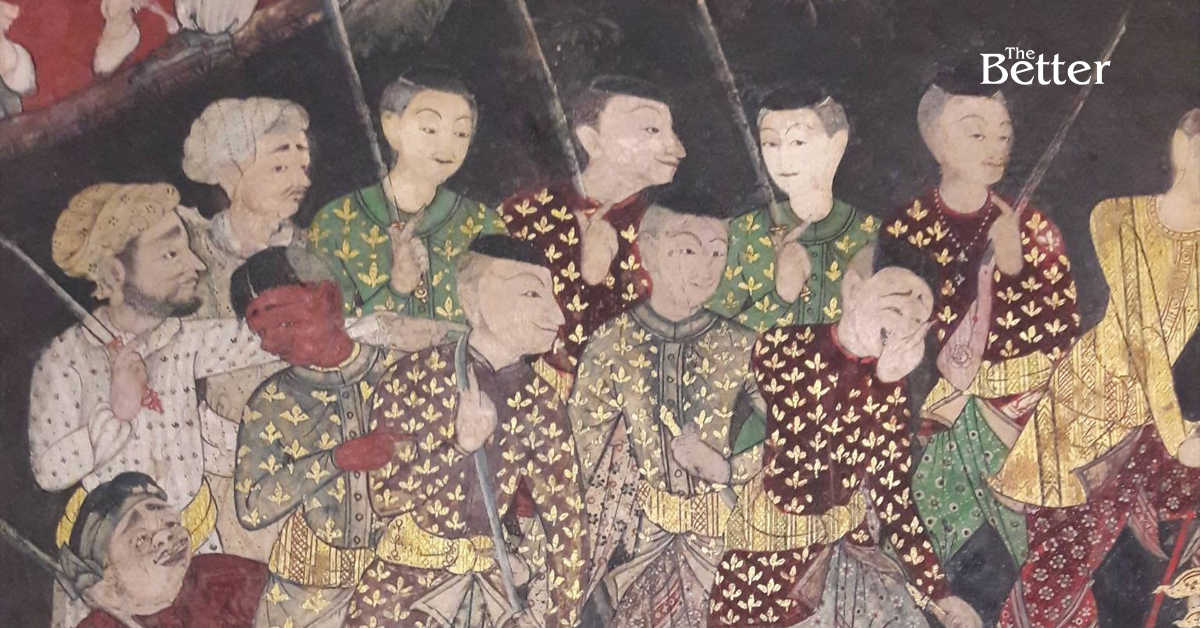
Photo - Mural painting at Wat Suwannaram, Bangkok, depicting the Mahosadha Jataka, with images of Persian among the Thais. (Photo by author)