
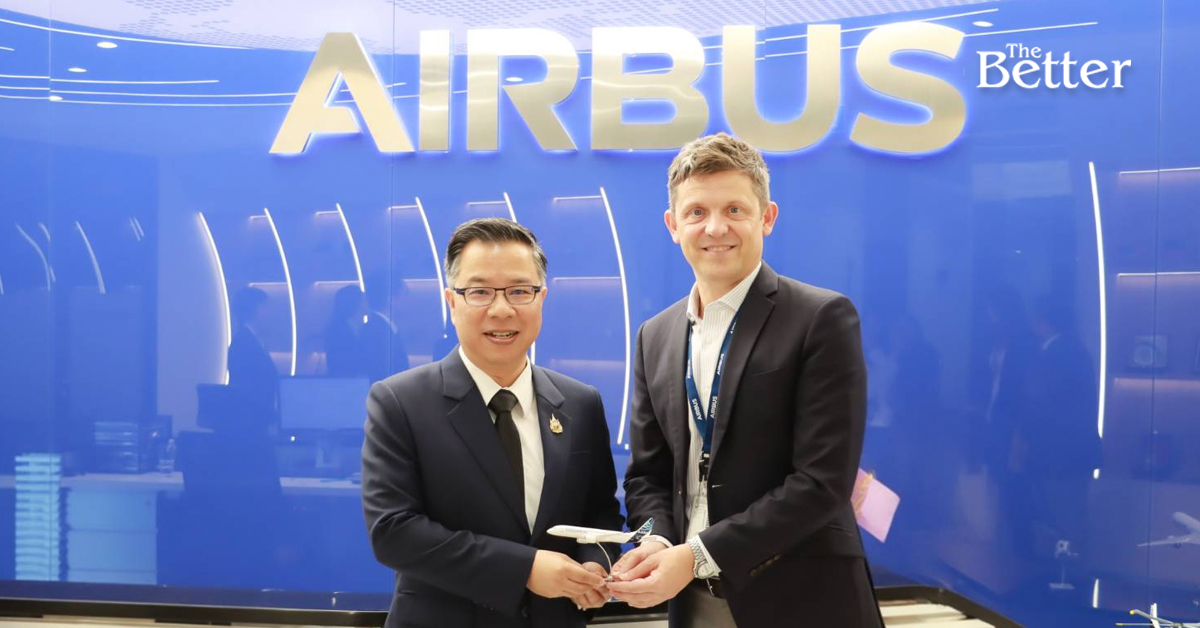
Narut Teodsathirasak, Secretary-General of the Board of Investment (BOI), said following a meeting with Bert Porteman, President of Airbus Thailand, that Airbus regards Thailand as one of its key business bases and is expanding its operations in the country, particularly in digital aviation technologies and services.
Airbus has established a regional Flight Operations Center of Excellence in Thailand under Skywise, its digital aviation business. Thailand serves as a regional base for Skywise, overseeing operations across Asia and supporting the development of aviation systems using advanced digital and modern aviation technologies.
Airbus currently employs more than 200 people in Thailand, more than three times the number employed in 2022. About 85% are Thai nationals, including aerospace engineers, software engineers, graphic designers, technicians, and other highly skilled professionals. The company plans to further expand its operations in Thailand and expects to hire an additional 40 employees this year.
During the meeting, the BOI and Airbus also discussed ways to strengthen Thailand’s aviation industry. Key areas include leveraging Thailand’s established automotive parts industry to expand into the aircraft supply chain, developing skilled personnel to support the aircraft maintenance, repair and overhaul (MRO) sector, and promoting Thailand as a production and development base for sustainable aviation fuel (SAF).
Airbus Deepens Its Presence in Thailand
Airbus, Europe’s largest aircraft and defence systems manufacturer, has operated in Thailand for more than 40 years. The company currently has more than 150 Airbus commercial aircraft operating in Thailand, with major customers including Thai Airways, Bangkok Airways, Thai AirAsia, and Thai Vietjet.
Airbus also has nearly 80 helicopters operating in Thailand, most of which are used by military and government agencies.
The company has established partnerships with several Thai organisations. These include cooperation with the Geo-Informatics and Space Technology Development Agency (GISTDA) on the development, production and launch of the THEOS-1 and THEOS-2 Earth-observation satellites; collaboration with the Thai Aerospace Industries Association (TAI) on military aircraft maintenance; and cooperation with the CP Group on the development of sustainable aviation fuel.
These partnerships have also contributed to significant technology and knowledge transfer to Thailand.
Thailand to Become Skywise’s Regional Digital Hub
A major focus of the discussions was the expansion of Airbus’s Skywise operations in Thailand. Skywise develops digital solutions for airlines, covering areas such as pilot manuals, flight data analysis, safety management, flight and crew planning, and predictive aircraft maintenance. Its solutions are built on a big-data platform designed to improve airline operational efficiency.
Airbus is currently expanding its Skywise software testing team in Thailand to strengthen quality control before software is delivered to customers and airlines. Thailand will serve as the company’s sole software testing base for solutions serving global customers.
Airbus is also continuing to recruit software engineers to support these activities and plans to establish Bangkok as Skywise’s regional headquarters for Asia, covering ASEAN, China, India, Japan, and South Korea.
“Airbus’s expansion of Thailand’s role in digital activities serving global customers, together with Bangkok’s development as Skywise’s regional business base, reflects Thailand’s readiness to support advanced technologies, including engineering, software testing, and aviation technologies requiring highly skilled personnel,” Narut said.
“This will create quality jobs and provide greater opportunities for Thai professionals to participate in the global aviation industry,” he added.
Thailand Eyes Greater Role in Global Aircraft Supply Chains
Airbus executives estimate that global passenger traffic and the size of the commercial aircraft fleet will double over the next 20 years, generating demand for more than 20,000 new aircraft.
Airbus currently has more than 9,000 aircraft on order, equivalent to more than a decade of production capacity. However, expanding production remains challenging because of supply-chain constraints and shortages of skilled personnel.
Rising raw-material costs and geopolitical tensions are also prompting aircraft manufacturers to diversify their supply chains and reduce risks.
Airbus sees Thailand’s geopolitical neutrality and skilled workforce as important advantages that could enable the country to play a greater role in global aircraft supply-chain diversification.
The company believes Thailand should identify specific areas in which it can develop specialised expertise while building on existing strengths, particularly in automotive parts and high-precision component manufacturing.
Potential areas for expansion include aircraft structures, composite materials, and aircraft interior components. However, entering the aircraft supply chain requires rigorous certification, high-quality and safety standards, and a highly skilled workforce.
This will require closer cooperation between international companies that can provide technology and expertise and Thai companies seeking to build long-term capabilities. Airbus currently has approximately 80 Tier 1–3 suppliers in Thailand.
Developing Talent for MRO and Advanced Aviation
Human-resource development is another key area of cooperation. Airbus works with several Thai universities, including King Mongkut’s Institute of Technology Ladkrabang, Kasetsart University, and Chulalongkorn University, to develop aerospace engineering curricula that reflect industry requirements.
The programmes increasingly incorporate digital technologies and artificial intelligence, as well as skills needed to work in an international aviation environment.
In the MRO sector, Airbus currently works with Thai companies involved in helicopter and military aircraft maintenance.
Thailand faces challenges in developing large-scale commercial MRO facilities, particularly because of a shortage of qualified maintenance technicians and increasingly stringent international training requirements.
Airbus, however, is prepared to contribute its expertise to Thailand’s human-resource development efforts, helping build the skilled workforce needed to support the country’s ambitions to become a regional aviation hub.
The BOI and Airbus view the development of digital aviation services, aircraft-component manufacturing, MRO capabilities, skilled personnel, and SAF as key pillars for strengthening Thailand’s position in the global aviation industry.
The Better News English