
Analysis: Why China Is Unlikely to Back Prince Norodom Chakravuth to Replace the Hun Family
In recent months, Some news outlets in Thailand have claimed that China is considering supporting Prince Norodom Chakravuth, a member of the Cambodian royal family, to replace the Hun family as Cambodia’s ruling political force, allegedly because of difficulties in maintaining control and recurring political problems.
The reports also claim that senior officials of the Chinese Communist Party have met with Prince Chakravuth.
I cannot definitively determine whether these claims are true or false. However, there are several points that should be considered when assessing the credibility of such speculation.
First, it is important to understand who Prince Norodom Chakravuth is.
Norodom Chakravuth is the eldest son of Prince Norodom Ranariddh, who was the eldest son of King Norodom Sihanouk.
King Sihanouk was not only Cambodia’s former monarch but also a major political figure who entered politics and led the royalist FUNCINPEC movement. Prince Ranariddh, another prominent member of the royal family, later became FUNCINPEC’s leader and played a central role in Cambodian politics during the 1990s.
Following Prince Ranariddh’s death, his son, Prince Chakravuth, became the leader of FUNCINPEC.
Today, however, FUNCINPEC has little political influence and holds no significant positions of power. Most of Cambodia’s political power remains concentrated within the Cambodian People’s Party (CPP), which has been dominated by the Hun family and its political network.
Prince Ranariddh and Hun Sen once shared power as co-prime ministers following the 1993 elections. Their political alliance eventually collapsed, however, and the relationship deteriorated sharply during the 1997 political crisis, forcing Prince Ranariddh into exile.
Although Prince Ranariddh later returned to Cambodia and remained involved in politics, FUNCINPEC was unable to regain its former influence. Following his death, leadership of the party passed to Prince Chakravuth.
Prince Chakravuth, however, has wielded considerably less political power and influence than his father. His role has largely been that of a figurehead leading a royalist political party whose influence has declined significantly.
Prince Ranariddh himself once argued that preserving the Kingdom of Cambodia required the existence of a political party committed to supporting the monarchy. In this context, FUNCINPEC’s continued existence can be viewed as part of Cambodia’s broader royalist political tradition, even though its influence today is far removed from the position it held in the 1990s.
One reason the Hun family remains politically resilient is that it has avoided taking an openly antagonistic approach toward China and has maintained close relations with Beijing.
For these reasons alone, I find it difficult to view Prince Norodom Chakravuth as a credible political alternative to the Hun family.
First, Prince Chakravuth lacks the political resources necessary to challenge the Hun family. He has limited political power, organizational networks, military influence, and financial resources. His principal asset is his status as a member of the Cambodian royal family. However, the monarchy itself has limited political influence in contemporary Cambodia, making royal status alone insufficient to establish an effective power base.
Second, even if the Hun family were somehow removed from power by an external force, Cambodia could face severe political instability. If Prince Chakravuth were installed as the country's new ruler without having an established political base, he could face challenges from other powerful groups within Cambodia, including rival political and business networks or opposition forces associated with figures such as Sam Rainsy.
Third, installing Prince Chakravuth under such circumstances could potentially create a power vacuum and increase the risk of political conflict or even civil unrest. China would have little incentive to pursue a course that could destabilize Cambodia, given the country's importance to China's strategic interests in Southeast Asia.
Fourth, and most importantly, the Hun family remains a reliable partner for China. The family's political power remains firmly established, while its influence extends across Cambodia's political, security, media, and economic spheres. Even following setbacks, Hun Sen has demonstrated a strong ability to maintain political support and project an image of national strength.
If Hun Sen and the broader Hun family remain capable of maintaining political stability while facilitating China's strategic interests, why would Beijing seek to replace them?
These factors are all related to Cambodia's internal political structure.
There is, however, another issue that is frequently cited as evidence that China may be supporting Prince Chakravuth: meetings between the prince and senior Chinese officials.
I have observed that Prince Chakravuth has met with senior Chinese officials relatively frequently, in some cases almost annually in recent years.
For example, in 2023, Liu Jianchao, then head of the International Department of the Central Committee of the Communist Party of China, met with Prince Chakravuth to discuss the results of that year's general election.
In 2024, Qu Qingshan, a member of the Central Committee of the Communist Party of China, led a CPC delegation to Cambodia. Qu met with Hun Sen, Prak Sokhonn, and Prince Chakravuth, among others. This suggests that the meeting was not necessarily a secret or exclusive engagement.
Moreover, Qu Qingshan served as head of the Institute of Party History and Literature of the CPC Central Committee, meaning that his institutional role was primarily related to party history and literature rather than direct responsibility for China's foreign policy. The meeting, therefore, should not automatically be interpreted as evidence of a political plan to elevate Prince Chakravuth.
In 2025, Chen Zhou, who serves as Vice Minister of the International Department of the CPC Central Committee, also met with Prince Chakravuth. However, before meeting with the prince, Chen Zhou primarily engaged with the Cambodian People's Party, which had invited the Chinese delegation. The meetings included Hun Manet, senior CPP officials, and Prince Chakravuth.
In my view, these meetings are not unusual.
First, the meetings involving Prince Chakravuth were not necessarily exclusive encounters. Chinese officials have also maintained extensive contacts with the Hun family and other senior Cambodian political figures.
Second, China's engagement with opposition or non-ruling political parties does not necessarily mean that Beijing supports those parties as alternatives to the government in power.
Otherwise, one could argue that China's engagement with Pita Limjaroenrat, the former leader of Thailand's Move Forward Party, including his attendance at China's National Day celebrations and meetings with Chinese diplomatic representatives, constituted evidence that Beijing supported him. Clearly, such meetings alone do not establish political alignment.
Similarly, the fact that Chinese officials meet Prince Chakravuth does not necessarily mean that China is preparing to support him as an alternative to the Hun family.
A more plausible explanation may lie in the longstanding relationship between China and the Norodom royal family, which dates back to the era of Prince Norodom Sihanouk. Sihanouk maintained particularly close ties with China and spent considerable periods there. Although Prince Chakravuth's own relationship with China may have been less extensive because of his time in exile in France, he remains a prominent member of the Norodom family and the leader of FUNCINPEC, the royalist party historically associated with the monarchy.
China therefore has a longstanding reason to maintain relations with both the Norodom family and FUNCINPEC.
This is evident in statements made by senior Chinese officials. Liu Jianchao, for example, praised FUNCINPEC for maintaining the China-friendly policy established by Prince Norodom Sihanouk and expressed China's willingness to strengthen exchanges and cooperation with the party in order to promote the continued development of China-Cambodia relations.
Prince Chakravuth, speaking on behalf of FUNCINPEC, expressed gratitude for the longstanding support provided by the Communist Party of China and the Chinese government to the Cambodian royal family.
These statements indicate that Beijing views FUNCINPEC and the Norodom royal family as longstanding components of Cambodia's political landscape and of the broader historical relationship between China and Cambodia. That does not necessarily mean that China views them as a potential replacement for the Hun family.
I do not have sufficient information to make a definitive assessment of the precise nature of China's current relationship with the Norodom family. However, China's broader foreign-policy approach provides another important point of reference.
Beijing has consistently emphasized the principle of non-interference in the internal affairs of other countries. If this principle is applied consistently, China would have little incentive to actively engineer regime change in Cambodia, particularly when the existing government is already a close strategic partner.
Even if China were to consider supporting a political transition, it would be difficult to see what strategic advantage Beijing would gain from deliberately destabilizing a government that already serves many of its interests.
The comparison with the United States is also relevant, although the two countries have very different foreign-policy traditions and methods. The United States has historically demonstrated a greater willingness to intervene in the domestic political affairs of other countries, including supporting political transitions when Washington considered them strategically advantageous. China's approach has generally been more focused on maintaining stable relationships with existing governments.
Ultimately, the key question is not whether Chinese officials have met Prince Chakravuth. They clearly have.
The more important question is why those meetings took place and what Beijing stands to gain from them.
At present, there appears to be a much stronger strategic rationale for China to maintain its relationship with the Hun family than to attempt to replace it with a politically weak and relatively unestablished alternative.
The Hun family's regime is already broadly favorable toward China. If the existing arrangement provides Beijing with political stability, economic access, and strategic benefits, there is little obvious reason for China to take the considerable risk of attempting to engineer a change.
Therefore, while rumors about Chinese support for Prince Norodom Chakravuth are worth examining, meetings between Chinese officials and the Cambodian prince should not, by themselves, be treated as evidence that Beijing is preparing to replace the Hun family.
By Kornkit Disthan, Assistant Managing Editor and Foreign News Editor, The Better
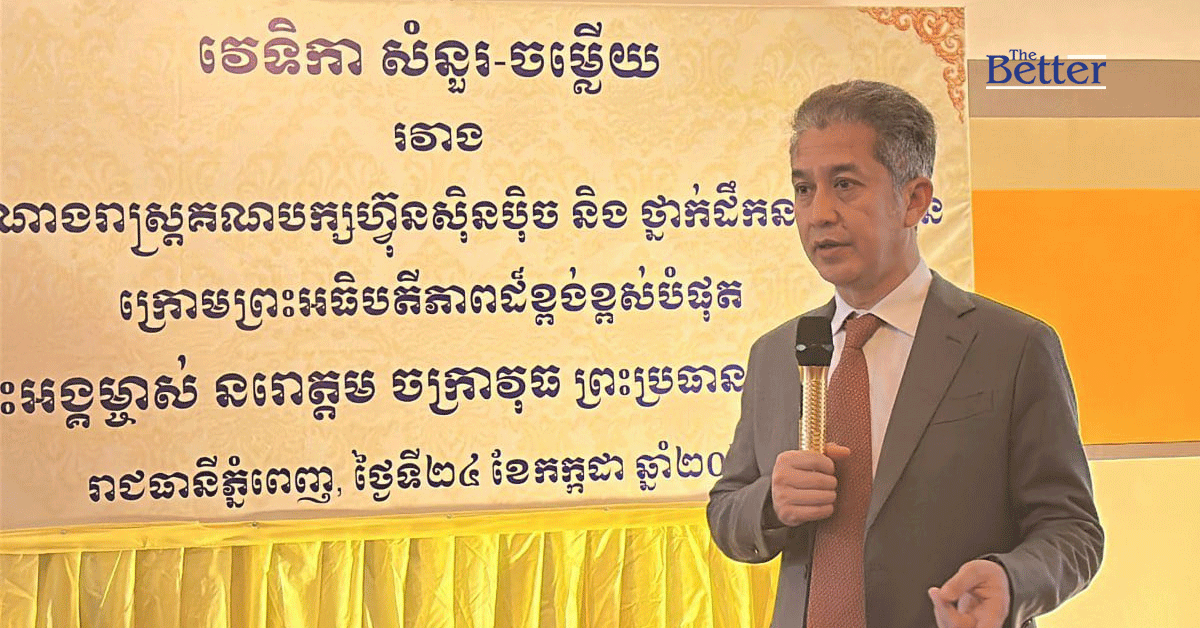
Photo - គណបក្ស ហ៊្វុនស៊ិនប៉ិច/ Funcinpec Party / Facebook