
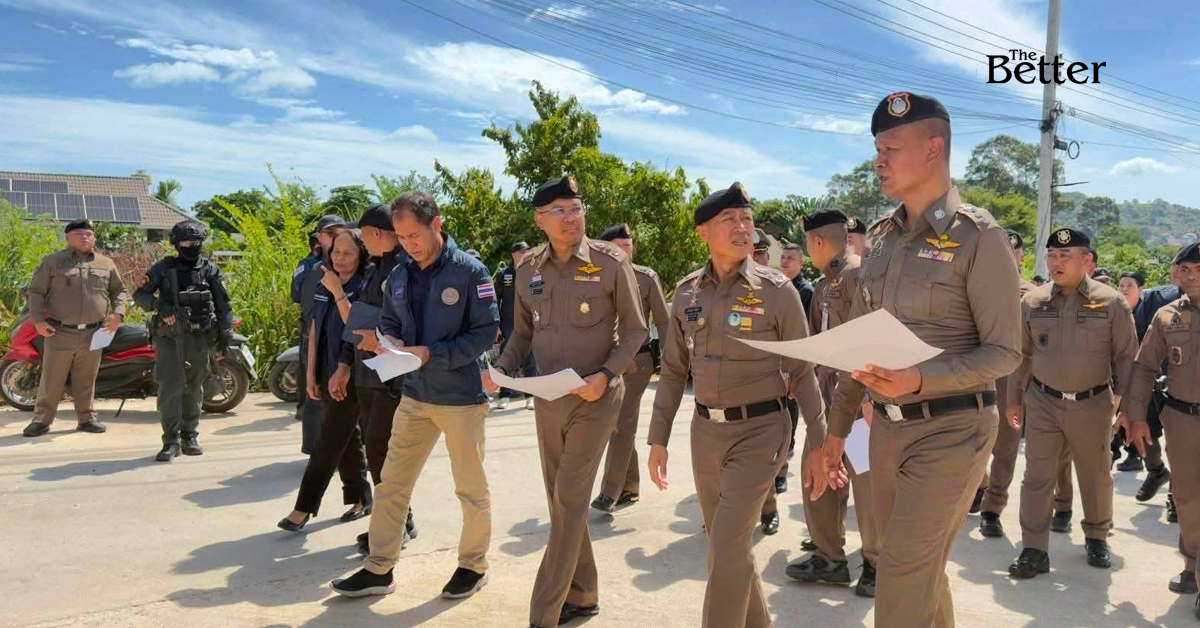
Deputy Interior Minister Pol. Gen. Peerapong Suwannachawi, together with Pol. Gen. Samran Nuanma, Deputy National Police Chief; Pol. Lt. Gen. Surapong Thanomjit, Assistant National Police Chief and Acting Commander of Provincial Police Region 8; the Governor of Surat Thani; officials from the Department of Business Development; and the Department of Special Investigation (DSI), mobilized more than 300 officers to launch “Operation Dismantle Foreign Nominee Network Phase 7” in Koh Samui District, Surat Thani Province.
The operation targets illegal foreign business activities, particularly the use of Thai nationals as legal nominees to hold shares, property, or other assets on behalf of foreign investors in violation of Thai law.
The latest operation follows investigations stemming from the so-called “Koh Phangan Model.” Authorities previously inspected 12,906 companies on Koh Samui, identifying 8,254 companies with foreign shareholders. Of these, 875 were suspected of using Thai legal nominees. Further investigations identified 59 companies as suspects.
Authorities found that the 59 companies collectively owned 37 plots of land and buildings covering more than 31 rai, with an estimated value of approximately 1.2 billion baht. The investigation has resulted in 60 cases involving 88 suspects—26 Thai nationals and 62 foreigners.
The Koh Samui Provincial Court subsequently issued 37 search warrants, and authorities have so far arrested 14 suspects. Those arrested include four Chinese nationals, four British nationals, and one each from Italy, France, the Netherlands, Austria, the Philippines, and the United States.
Five Key legal nominees Networks Under Investigation
Authorities focused the latest search operation on five major business networks operating through different models.
The first, known as “Galp-Tree,” is an Israeli-linked network comprising 19 companies. Investigators found a multilayered corporate structure allegedly involving Thai nominees. The businesses were also linked to unlicensed preschool childcare operations, as well as the purchase, development, sale, and rental of luxury villas to foreign clients.
The second network, “Hole-C,” consists of four German-linked companies involved in real estate and the construction of luxury villas on steep mountain terrain. Authorities are examining potential violations involving construction permits, the sale of villas through changes in the shareholding structures of nominee companies, and possible tax evasion related to land transactions and corporate income.
The third network, “Kamol,” involves 27 companies established by Thai nationals allegedly for foreign nationals to use in obtaining work permits or long-term business visas. Investigators found discrepancies between the companies’ registration information and their actual business operations.
The fourth network, “Pa,” comprises 16 companies initially established by Thai nationals allegedly to circumvent document-verification procedures. Foreign nationals were subsequently added to the shareholder structures to obtain work permits and change their visa status to business visas. Authorities, however, found no evidence of the business activities declared in the companies’ registration documents.
The fifth network, “I,” consists of two companies. The investigation originated from information provided by the French Embassy in Thailand concerning alleged fraud linked to an investment in a cannabis farm, with reported damages exceeding 21 million baht.
Alleged Fraud and Unlicensed Hotel Operation
An investigation by immigration authorities in Surat Thani found that funds allegedly lost by French victims were used in a scheme involving Thai nationals acting as nominees to purchase land and develop a luxury property featuring a swimming pool and tennis courts.
The investors also allegedly established another company to manage the property, using a lease agreement to obscure the actual ownership and business arrangements. The property was reportedly advertised online for daily rentals ranging from 11,000 to 17,000 baht per night. Authorities said they found no hotel operating license for the property.
Crackdown to Expand Nationwide
Pol. Gen. Samran said Phase 7 is part of a broader crackdown on foreign nominee networks in major tourist destinations. The six previous phases investigated 238 companies and 272 plots of land covering more than 184 rai, with an estimated combined value of land and buildings of approximately 2.839 billion baht. Authorities also obtained 178 arrest warrants.
The latest operation on Koh Samui aims to strengthen oversight of the island, one of Thailand’s major tourism destinations, and ensure that foreign investments and business activities comply with Thai law. Authorities also seek to prevent nominee arrangements from being used to circumvent legal restrictions or adversely affect the livelihoods and legitimate business opportunities of Thai citizens.
Relevant agencies are preparing to expand investigations into nominee networks, including examining whether government officials may have been involved in corruption or facilitated illegal activities.
Authorities said similar operations will continue in other major tourist destinations nationwide. The public is encouraged to report information concerning suspected illegal activities involving foreign investment groups to local police stations or the 1599 hotline, which operates 24 hours a day.
Meanwhile, Poonpong Naiyanapakorn, Director-General of the Department of Business Development (DBD), revealed that on Friday, August 14, 2026, he assigned M.L. Phuthong Thongyai, Deputy Director-General of the DBD, together with the department’s nominee suppression team from the Illegal Business Prevention and Suppression Division, to participate in a joint operation led by Deputy Interior Minister Pol. Gen. Peerapong Suwannachawi.
The operation involved officials from the Department of Provincial Administration, Department of Lands, Department of Employment, Immigration Bureau, Surat Thani Province, Koh Phangan District, Koh Phangan Police Station, and relevant local administrative agencies.
The joint operation focused on inspecting businesses suspected of using Thai nationals as nominees to conceal foreign ownership or conduct business in violation of Thai law. Each participating agency was instructed to take action within its respective legal authority.
The Ministry of Commerce, through the DBD, inspected businesses for potential violations of the Foreign Business Act. The Ministry of Interior examined hotels and accommodation businesses allegedly operating without the required permits, while the Ministry of Labour investigated potential cases involving the illegal employment of foreign workers.
Four Locations Targeted
Officials conducted inspections at four locations on Koh Phangan.
1. Large Resort Hotel
The first location was a large resort hotel occupying more than 25 rai of land. A Thai director initially provided information about the company’s operations. However, further investigation found that he held shares in several companies with foreign investors.
Authorities noted several suspicious circumstances, including the shareholder’s inability to provide complete information about the businesses and investments in question. Further checks also revealed that he held directorships or shares in several other companies, prompting officials to expand their investigation.
2. Villa Rented to Foreign Tourists
The second location was a villa reportedly rented to foreign tourists. Officials found Israeli tourists staying at the property, who reportedly paid rental rates of tens of thousands of baht per night.
Investigators are examining the payment arrangements, including online payments made from overseas rather than payments in Thai baht at the property, as part of their inquiry into the business’s financial and tax compliance.
Authorities also found that the Thai shareholder connected to the property served as a director and shareholder in several other companies, prompting further investigation into the ownership and business structure.
3. Cannabis Retail Business
The third location was a cannabis retail business operated by a company with foreign shareholders. The company reportedly operates four branches in Koh Phangan, Koh Samui, Phuket, and Bangkok.
Officials found that the business sold controlled herbal products under Form 33 for 300 baht per prescription, along with various cannabis-related products. The company’s most recent financial statements reportedly showed revenue of approximately 15 million baht.
Investigators are examining the company’s ownership structure and business operations, particularly the role of its Thai shareholder, who also holds directorships and shares in multiple other companies.
4. Luxury Hillside Villa
The fourth location was a luxury villa situated on a high hillside. When officials arrived, the property was closed and no one was available to provide information about its ownership or operations.
Officials found that the land title deed was registered in an individual’s name. Further investigation into the ownership of the land, the property, and any associated business activities will therefore be required.
Authorities Move to Review Land Holdings
Surat Thani Province currently has 25,603 registered legal entities. Pol. Gen. Peerapong Suwannachawi has instructed the Department of Lands to take action, through the authority of the provincial governor, concerning 104 legal entities holding a total of 124 plots of land.
Authorities have been instructed to convene a meeting and take immediate steps regarding the disposal or sale of the land where legally warranted.
Meanwhile, the Department of Business Development has been instructed to intensify investigations into suspected nominee arrangements and take decisive legal action against businesses found to have violated the law.
Officials emphasized that the ongoing operation is intended to ensure that businesses operating in major tourist destinations comply with Thai laws and regulations, while preventing the use of Thai nominees to conceal foreign ownership or circumvent restrictions on foreign business activities.
Furthermore, any Thai national found to be facilitating or accepting money or other benefits in exchange for acting as a nominee to conceal foreign ownership will face criminal charges under Section 36 of the Foreign Business Act B.E. 2542 (1999). The offense carries a penalty of up to three years’ imprisonment, a fine ranging from 100,000 to 1 million baht, or both.
Foreign nationals who illegally conduct business in Thailand without the required permission may also face penalties under Section 37 of the Act.
Many foreign nationals have legally invested and conducted business in Thailand, and the Department encourages foreign investors and business owners, as well as those providing investment advice, to comply fully with Thai law. The Department is ready to facilitate and provide guidance to ensure that legitimate businesses can operate in accordance with the law.
At the same time, Thai nationals who are involved in facilitating illegal nominee arrangements are urged to report such activities to the authorities. Those who are currently assisting foreign nationals in circumventing the law through nominee arrangements are also urged to stop such practices and act in the best interests of the country.
The Better News English