
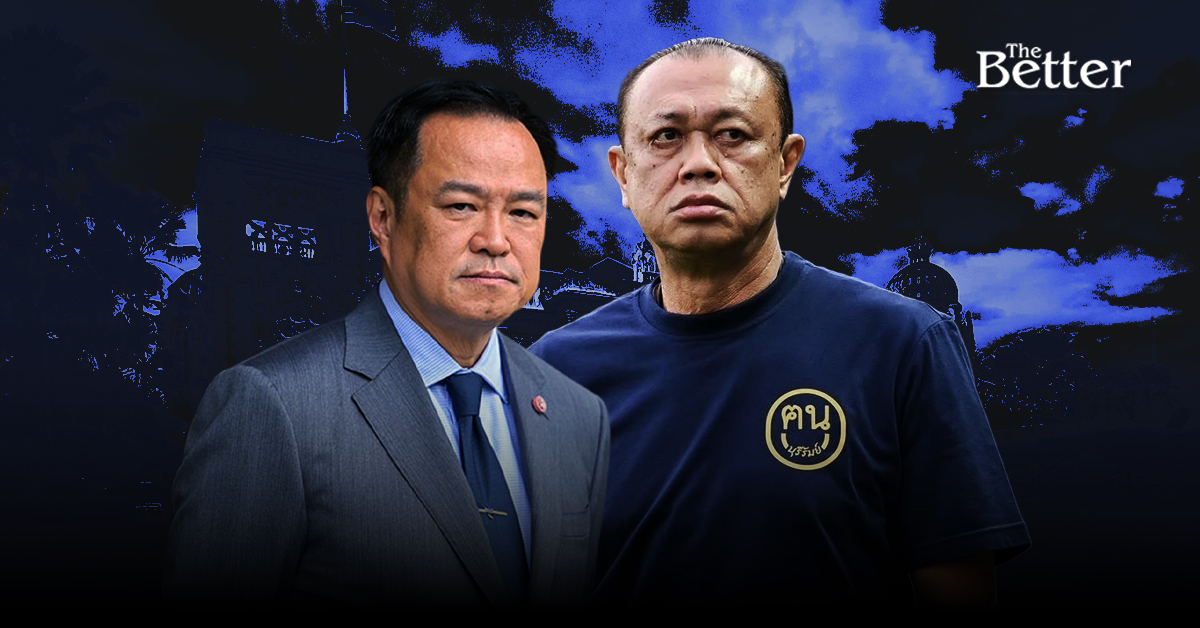
Why Anutin Is Unlikely to Serve a Third Term as Thailand’s Prime Minister
Newin Chidchob, widely regarded as the real “big boss” behind the Bhumjaithai Party, appears to have sent a clear political signal: there may be no third term for an Anutin-led government.
It must be acknowledged that Newin, who has long been regarded as the driving force behind many of Bhumjaithai’s major political decisions, possesses an unusually sharp understanding of Thai politics. Born into a political family, he gained firsthand experience from the grassroots upward as the son of Chai Chidchob, affectionately known as “Grandpa Chai”, a veteran politician from Buriram who rose from local politics to the national stage and dominated the Buriram constituency for decades.
Chai Chidchob was elected as an MP from Buriram from 1957 and went on to become one of the most influential political figures in the province. His highest legislative position was Speaker of the House of Representatives, a position he held from 2008 to 2011.
It was during this period that Newin played a crucial role in securing the Speakership for his father. He subsequently led the “Friends of Newin” faction out of the People’s Power Party and helped form a coalition government with the Democrat Party under then-Prime Minister Abhisit Vejjajiva. These manoeuvres demonstrated Newin’s ability to read the political landscape and position himself and his allies at critical moments of political transition.
For more than five decades, Chai Chidchob was a major figure in Thai politics, playing a role in several important political realignments and government changes. A veteran political operator who moved between political parties throughout his career, he developed an extensive understanding of the country’s political power structure.
It is therefore hardly surprising that his son, Newin, absorbed much of that political instinct. His ability to read political trends, understand alliances and anticipate shifts in power has become one of his most important assets.
Against this background, Newin’s latest signal should not necessarily be interpreted as a judgment that Anutin Charnvirakul has failed or is incapable of leading the government. Rather, it may reflect Newin’s assessment of the political cycle ahead and what he believes is necessary for Bhumjaithai to survive and remain competitive in the next election.
There are at least three possible interpretations.
1. Bhumjaithai may already have reached its political peak
One interpretation is that Newin believes Bhumjaithai has reached the peak of its electoral success.
The party won 191 seats in the latest election, making it the largest party in the House of Representatives. But Newin may also recognise that political parties rarely remain at the top indefinitely. Thailand has seen this pattern before with parties such as the Democrats, Pheu Thai and Chart Thai, which enjoyed periods of dominance before gradually losing ground.
From this perspective, the next election could mark the beginning of a downward cycle for Bhumjaithai. If the party's popularity continues to decline, Anutin's chances of returning as prime minister could become increasingly difficult.
There are already signs that the party's popularity is considerably weaker than it was at the height of its electoral success.
2. Newin may be preparing a generational overhaul
A second possibility is that Newin wants to restructure Bhumjaithai by bringing younger leaders to the forefront and developing a new generation of political figures capable of appealing to younger voters.
Such a strategy would not necessarily concern Anutin alone. Other senior figures, including Deputy Prime Minister and Transport Minister Pipat Ratchakitprakarn, could also be affected by a generational transition. There have been signals that Pipat may not return to the Cabinet in the next government and that the party should identify younger figures to take over.
This has inevitably fuelled speculation that Newin could eventually promote his son, Chaichanok Chidchob, the Minister of Digital Economy and Society, as a potential future prime ministerial candidate.
However, such a move would be far from straightforward. Chaichanok has already faced criticism over his qualifications and controversy surrounding the TH-AI Passport project, including questions about the transparency and value of the 1.6-billion-baht initiative. Turning him into a credible prime ministerial candidate would therefore require considerable political rehabilitation and a much stronger public profile.
3. Newin may simply be warning Anutin to be more careful
The third interpretation is perhaps more immediate: Newin may be sending a message to Anutin that he must recognise the difference between being a political party leader and being the Prime Minister of Thailand.
As prime minister, Anutin is no longer simply “Anutin”. Every statement, public appearance, political decision and even online activity carries consequences for the government and the party.
The message may therefore be less about removing Anutin and more about forcing him to become more disciplined and cautious.
There have recently been signs of this change. In interviews with the media, the Prime Minister has appeared increasingly selective, speaking only when necessary and avoiding situations in which an off-the-cuff comment could create political problems.
In Thai politics, one careless remark can sometimes become a much bigger political problem than the issue it was intended to address.
Anutin's government faces a growing popularity problem
Whatever Newin's ultimate intention may be, one fact is difficult to ignore: the popularity of Anutin's government has declined.
Although the government commands a strong majority of 292 votes in the House of Representatives, parliamentary strength does not necessarily translate into public support.
Since Anutin took office on March 20, 2026, his government has faced a series of controversies. One of the earliest criticisms concerned the formation of what opponents described as a “cabinet of privileged individuals”, with ministerial positions perceived to have been allocated according to the influence and quotas of powerful political families.
The government also came under pressure over high oil prices during the Middle East conflict. Hoarding by traders contributed to widespread hardship, while the government's response was criticised as insufficient to control the situation and restore stability.
Then came a series of longstanding political controversies.
These included the election-collusion case involving senators and the long-running Khao Kradong land-encroachment dispute in Buriram, which the opposition has repeatedly brought back into the political spotlight.
The government has also faced questions over the transparency of the bidding process for the TH-AI Passport project. More recently, the nationwide local-government recruitment examination became embroiled in a major controversy after evidence of irregularities led to the cancellation of the original examination results. Several individuals connected to the government and Bhumjaithai have been drawn into the controversy.
Taken together, these controversies have created an increasingly difficult political environment for Anutin.
Not everything has been negative for the government.
One initiative that appears to have generated some degree of public support is the “Thai Help Thai Plus 60:40” programme, under which the government provides financial support for citizens to spend at participating shops over a four-month period from June to September.
Under the programme, eligible citizens receive a monthly spending allowance of 2,500 baht, with the government covering 60% of the purchase cost while citizens contribute the remaining 40%, or up to 1,000 baht.
The government is also considering expanding the programme into a second phase in an effort to strengthen public satisfaction and provide additional economic stimulus.
Whether this will be enough to reverse the government's declining popularity, however, remains uncertain.
The bigger question is Anutin's political relevance
Despite the speculation surrounding his political future, Anutin himself remains confident that he is indispensable to Bhumjaithai.
His extensive personal relationships across Thailand's political and state power structures, combined with his connections to other political parties and influential figures, have given him a unique position within the country's political equation.
From Anutin's perspective, Bhumjaithai's success cannot easily be separated from his own political role.
Opinion by Wut Nontarit Executive Editor fo The Better News