
Is Thailand’s Economy Heading for a Collapse?
A few months ago, Hanke’s Annual Misery Index (HAMI) was released, ranking countries according to economic indicators to determine which economies are the most “miserable.” Taiwan ranked 178th globally, placing it at the bottom of the misery scale and making it the “happiest” economy on the list.
Singapore ranked second, while Thailand came in third. Thailand’s ranking reflected its low inflation rate and stable employment, with consumer prices falling by 0.3%, an unemployment rate of just 0.8%, and real GDP per capita growth of 2.5%, according to the South China Morning Post.
The HAMI therefore paints a relatively positive picture of Thailand. So I want to ask all Thais a simple question: “Are we still happy?”
If you are still comfortable with the state of the country and its economy, then I congratulate you. Perhaps the HAMI results accurately reflect the reality of Thailand.
However, recently I have seen a growing number of foreign “experts” producing videos promoting the narrative that “Thailand is collapsing.” This appears to contradict the relatively positive picture presented by the HAMI.
The message they convey is broadly similar: Thailand’s economy is in decline, there is little future for its industrial sector, the birth rate is falling, and the population is rapidly aging. In short, they portray a country in which almost nothing is going right.
By this narrative, Thailand is arguably becoming one of the most economically troubled countries in the region.
The rise of “Thailand is collapsing” content has coincided with the release of GDP figures from several Southeast Asian countries, almost all of which recorded faster economic growth than Thailand, with Singapore being the notable exception. This has further reinforced the perception that “Thailand is truly collapsing.”
Or, at the very least, it has made many Thais realize one uncomfortable truth:
“We are being left behind.”
But some Thais argue that almost all of the ASEAN countries growing faster than Thailand have smaller economies. Compared with a large economy like Thailand’s, they say, it is like ants chasing an elephant.
I would like to think that way too. But we really have to admit that there is some truth behind the growing wave of content claiming that “Thailand is collapsing.”
If we continue to comfort ourselves with that kind of reasoning, I fear we may become “boiled frogs”—failing to realize that the situation is getting hotter and more dangerous until it is too late.
Thais often say that we have resilience—the ability to adapt, withstand adversity, and survive difficult circumstances. But there is a fine line between resilience and simply becoming accustomed to a deteriorating situation.
I fear that we may no longer be demonstrating resilience. Instead, we may be gradually becoming accustomed to the heat, like the proverbial frog that does not realize the water is getting hotter until it is too late.
I am a patriotic person, like many others, and I admit that I often find myself biased in favor of my own country. So, when I see people focusing heavily on GDP growth, I try to reassure myself: “But Thailand’s per capita income is still very high.”
Certainly, Thailand’s GDP per capita remains among the highest in ASEAN. But when we look at the growth rate of GDP per capita, we find that it is moving at a sluggish pace—much like the country’s overall GDP growth.
Consider the following:
Countries growing faster than Thailand
- Vietnam: Ranked 15th in the world, growing at 6.4%
- Philippines: Ranked 30th in the world, growing at 4.8%
- Cambodia: Ranked 32nd in the world, growing at 4.8%
- Indonesia: Ranked 42nd in the world, growing at 4.2%
- Malaysia: Ranked 48th in the world, growing at 3.8%
- Brunei: Ranked 60th in the world, growing at 3.4%
- Laos: Ranked 80th in the world, growing at 2.9%
- Thailand: Ranked 87th in the world, growing at 2.6% (the HAMI index puts the figure at 2.5%)
Countries growing slower than Thailand
- Singapore: Ranked 97th in the world, growing at 2.3%
- Timor-Leste: Ranked 202nd in the world, contracting by 3.3%
If Timor-Leste is excluded, Thailand and Singapore are left at the bottom of the ranking.
And yet, both Thailand and Singapore are among the top performers in the HAMI index when it comes to economic “happiness.”
That is the contradiction we need to confront.
Perhaps Thailand is not collapsing. Perhaps we are simply becoming too comfortable with growing too slowly.
It is worth noting that while Singapore and Thailand rank among the countries with the lowest levels of economic distress, Malaysia, Cambodia, and Vietnam are also among the least distressed. Therefore, we cannot simply assume that Thailand’s slow economic growth means less economic hardship. Countries with much higher growth rates can also experience relatively low levels of distress.
The HAMI index is not fundamentally different from other economic indicators. If we look at individual economic figures, Thailand’s performance is not necessarily as strong as the HAMI ranking might suggest. However, the index is supported by two important factors: low inflation, which keeps prices relatively stable, and low unemployment, which helps prevent people from falling into severe economic hardship.
These two factors alone may be enough to prevent many Thais from experiencing extreme deprivation.
But the fact that people can still afford relatively inexpensive goods and retain their jobs does not necessarily guarantee a bright future.
Put simply, Thailand may have avoided extreme economic hardship, but it risks becoming a country that simply exists from day to day—comfortable with its current situation but uncertain about how to move forward.
In one respect, Thailand’s current economic position resembles that of developed countries: it has a large economy, but one that is growing slowly.
The difference is that Thailand is not a developed country. It is an upper-middle-income country seeking to join the OECD (Organisation for Economic Co-operation and Development).
The problem is that the OECD is largely made up of advanced industrialized economies. But what industries does Thailand truly own and control?
Beyond the tourism industry, which has yet to generate enough innovation and value-added development to create a new economic future, Thailand lacks a sufficiently strong industrial foundation to make the transition to a developed economy.
This leaves Thailand vulnerable to remaining trapped in the middle-income range. The path to becoming a high-income country becomes increasingly difficult when the foundations for building a new economic future are weak.
Many people may be angry when I say this, but I believe many of us are failing to recognize the reality facing our country. Instead, we choose to take pride in a diminishing past—like celestial beings in Buddhist cosmology who only enjoying themselves in heaven, believing their good fortune will last forever, only to discover too late that their good fortune can be depleted and once it's all gone a celestial being will become a degenerated being in lower realms.
Some even argue that because large Thai companies are investing heavily in neighboring countries such as Vietnam, they are contributing to those countries’ economic growth. Therefore, they argue, Thailand is not declining but simply expanding its economic influence abroad.
There are, however, two things we should consider.
First, some countries may count foreign investment primarily in terms of the initial capital entering the country, without fully considering how much of the profits generated by those investments eventually flow back to the investors’ countries of origin.
Both Vietnam and Thailand are heavily reliant on foreign direct investment (FDI), but the economic impact of FDI cannot be assessed simply by looking at the amount of capital entering a country. We also need to consider the subsequent outflow of profits and how much of the value created ultimately remains in the host economy.
This may help explain why some Vietnamese people question why their GDP is growing rapidly while many ordinary citizens still do not feel significantly wealthier. GDP per capita may be rising quickly, but it remains relatively low in absolute terms.
It is possible that Thailand’s slow GDP and GDP-per-capita growth are also partly related to similar economic leakages.
Second, we need to consider the movement of capital abroad. When large Thai companies invest overseas, does that represent the export of Thai wealth?
Whether through job creation, domestic investment, or the reinvestment of profits, capital invested abroad does not necessarily generate the same economic benefits at home. Profits can circulate internationally rather than remaining in the country where the capital originated.
As the saying goes, capital knows no borders—and increasingly, capital has no nationality.
Therefore, although Thailand has a large economy, its slow expansion translates into slow growth in GDP per capita. In practical terms, this means that Thais are becoming wealthier more slowly than people in many neighboring economies.
Furthermore, in a relatively free-market economy, large pools of capital can accumulate wealth much faster. We can see this particularly clearly in large market economies such as the United States.
The situation is less pronounced in many European countries because they have stronger social safety nets, combining market economies with welfare systems designed to redistribute some of the gains from economic growth.
This creates a worrying possibility: slow GDP-per-capita growth means Thais become wealthier more slowly, while inequality and economic vulnerability can deepen more quickly.
If this continues, Thailand may not only remain trapped in the middle-income range. More people could also be pushed into the informal economy, because the formal sector is no longer expanding sufficiently and more Thai capital is being invested abroad.
The movement of capital itself is not the problem. Capital naturally seeks the best opportunities and returns. Trying to prevent capital from moving is not necessarily the solution.
The real questions are: Why is domestic capital looking overseas for opportunities? Why is foreign capital leaving? And why is Thailand not attracting enough new foreign investment?
I raise these questions not because I have all the answers, but because finding a solution requires all of us to examine the problem from different perspectives. My own answer would only represent one point of view.
Finally, I want to add one more thought.
When Thais look at the disappointing state of their own country, some view it through the lens of nationalism. Others go even further into nationalistic fanaticism. In both cases, it can become difficult to distinguish genuine concern for the country from an emotional desire to defend it at all costs.
Much of this is rooted in extreme political polarization, in which political loyalties can overwhelm genuine concern for the country’s future.
If we can move beyond this careless hatred and uncontrolled fanaticism, I believe things can improve.
We may not be able to solve every problem immediately. But if we can develop a form of aspirational nationalism—one that wants the country to become better rather than merely insisting that it is already great—we may eventually find solutions.
People with this kind of mindset have helped countries facing crises far more severe than Thailand’s navigate periods of enormous uncertainty. Japan, South Korea, Singapore, and China all experienced periods when their futures were far from certain. They moved forward because they were willing to confront difficult realities, adapt, and think beyond the present.
It took time.
So, we should not be impatient—but neither should we be complacent.
Could Thailand find people capable of leading the country through its own difficult period?
Opinion by Kornkit Disthan, Assistant Managing Editor and Foreign News Editor, The Better
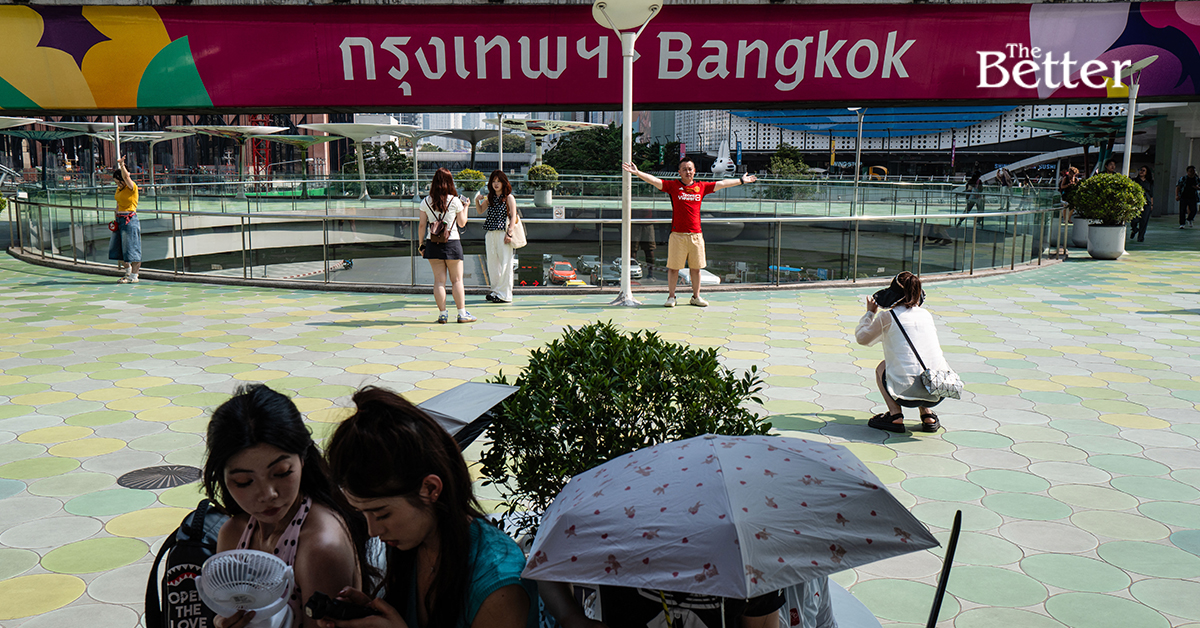
Photo - People rest indoors using umbrellas and portable fans, while some pose for photos on the elevated walkway at Pathumwan Intersection, Bangkok, on April 29, 2026 (Photo by ANTHONY WALLACE / AFP)