
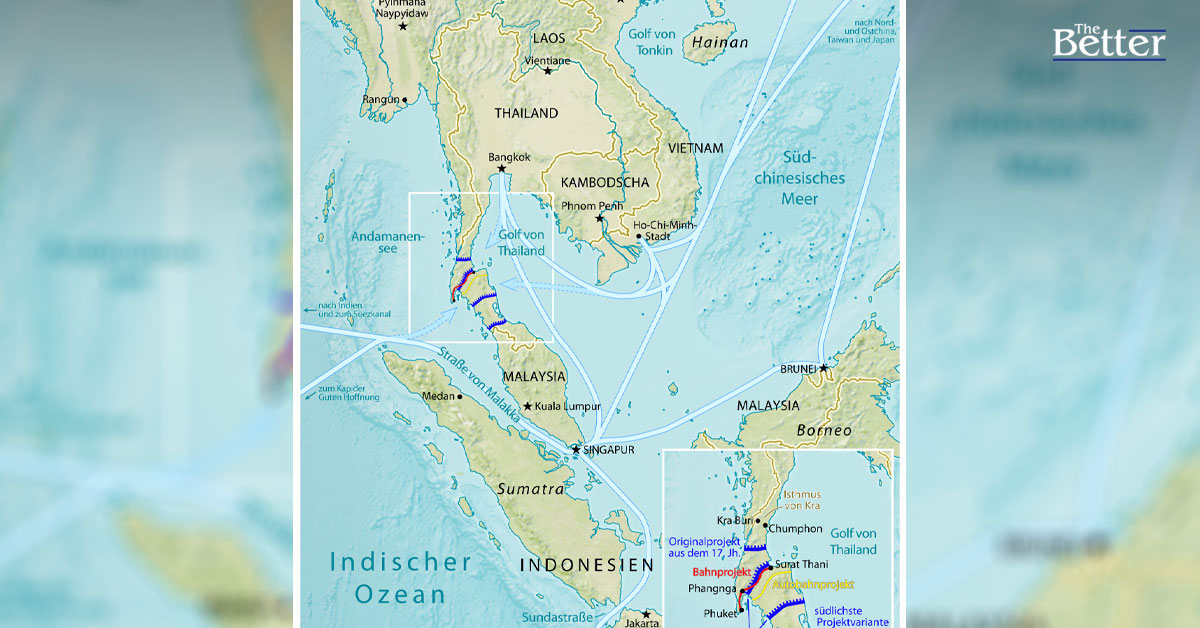
In 2020, Major Chieh Shiung Wayne Ho, a student at the U.S. Army Command and General Staff College, published a dissertation titled “The Impact of the Kra Isthmus Canal on Singapore’s Security.” The study examined how the construction of a canal across Thailand’s Kra Isthmus could affect Singapore’s economic and strategic position, particularly its role as a major regional maritime hub.
The dissertation reviewed several studies and assessments conducted over the decades, with differing conclusions about the potential impact of the proposed canal on Singapore.
1. Potential diversion of shipping from the Strait of Malacca
In recent years, some analysts have hypothesized that the construction of the Kra Isthmus Canal could divert as much as 30% of shipping traffic away from the Strait of Malacca and onto a new route through Thailand. Such a shift could potentially have a significant impact on Singapore’s economy, given the city-state’s dependence on maritime trade.
However, other assessments have argued that Singapore’s highly developed maritime infrastructure could mitigate the canal’s potential impact. Singapore has established itself as a major center for oil refining and storage, shipbuilding and ship repair, container handling, logistics and related maritime services. These capabilities could allow the city-state to retain a substantial portion of regional shipping-related business even if some vessels were to shift to a Thai canal route.
2. Early concerns date back to the 1930s
One of the earliest studies examining the potential impact of the Kra Isthmus Canal on Singapore was conducted by William J. Ronan in 1938. His study was based partly on speculation that Japan was interested in constructing a canal across the Kra Isthmus during the 1930s.
At the time, one scenario envisioned Singapore being “cut off from the world's major trade routes and potentially reduced to a third-tier port” if shipping were diverted through the Thai canal. The proposed canal would offer a shorter route between Europe and East Asia, potentially saving approximately two days for faster steamships and even more time for slower cargo vessels.
The concern reflected the strategic importance of Singapore’s location along the main maritime route between the Indian Ocean and East Asia.
3. A 1970s study predicted a limited economic impact
In 1973, the Thai government announced plans to conduct a feasibility study for the construction of the Kra Isthmus Canal. Against this backdrop, Patrick Low and Yue-Man Yeung of Singapore’s Institute of Southeast Asian Studies examined the potential impact of the project on Singapore.
After analyzing shipping statistics for vessels passing through Singapore, they concluded that the Kra Canal would divert no more than 10% of Singapore’s shipping traffic. As a result, they assessed that the economic impact would likely be relatively small and difficult to predict with precision.
The researchers also noted that Singapore had already begun transforming its economy. Rather than relying primarily on port activities and warehousing, the country was developing into a broader global trade and commercial hub. This economic diversification could reduce the potential vulnerability of Singapore to changes in regional shipping patterns.
4. A 2016 study estimated a larger economic impact
A subsequent study in 2016 by Ching-mu Chen and Satoru Kumagai took both qualitative and quantitative approaches to assess the potential consequences of the Kra Canal.
Their analysis estimated that the canal could reduce Singapore’s gross domestic product by approximately 0.8%, equivalent to around US$7 billion at the time. The researchers argued that shipping companies would have an incentive to select the shortest available route between destinations. Because a canal across the Thai peninsula would provide a shorter route than the existing passage through the Strait of Malacca and Singapore, some shipping traffic could potentially be diverted.
The findings therefore suggested a more substantial economic impact than earlier estimates.
5. Singapore’s infrastructure could provide a buffer
In 2017, Raymon Krishnan and Bhargav Srinagesh produced an assessment that took a more cautious view of the potential threat posed by the Kra Canal.
Their analysis acknowledged that a sufficiently developed Thai canal and associated infrastructure could potentially compete with Singapore in certain areas. However, they argued that physical infrastructure alone would not be enough to displace Singapore from its established position as a major maritime and commercial center.
Singapore’s advantage, they noted, extends beyond its physical port infrastructure. Its “hard” infrastructure is supported by sophisticated “soft” infrastructure, including technology, financial services, legal and regulatory systems, banking, and other institutions that facilitate international trade.
Taken together, the studies reviewed in Ho’s 2020 dissertation suggest that the potential impact of a Kra Isthmus Canal on Singapore remains difficult to quantify. While the canal could offer shipping companies a shorter alternative to the Strait of Malacca and potentially divert some maritime traffic, Singapore’s extensive infrastructure, financial ecosystem and role as a global trade hub could provide significant resilience.
The debate, therefore, is not simply about whether ships would choose a shorter route through Thailand. It also concerns whether a new maritime corridor could replicate the broader ecosystem of services that has made Singapore one of the world’s leading ports and commercial hubs.
The Better News English