
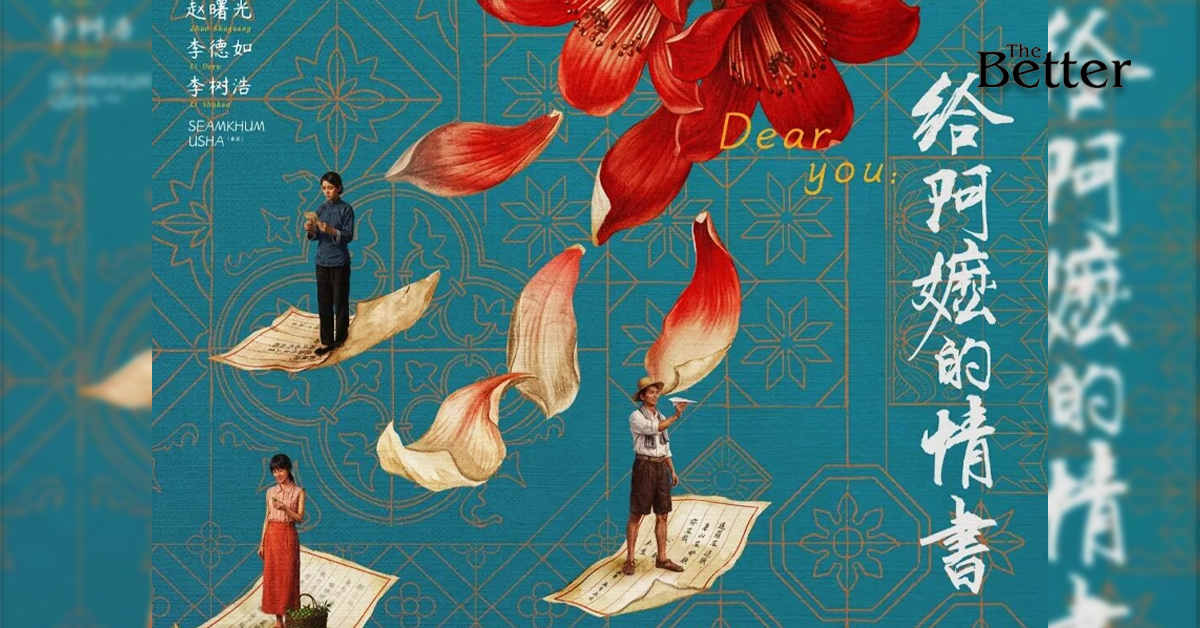
Before arriving in Thailand, almost everyone I spoke to had the same advice: bring plenty of tissues if you plan to watch Dear You (Chinese title: 给阿嬷的情书). They described it as one of the year's most emotionally moving films—a story guaranteed to leave audiences in tears.
The praise was not an exaggeration.
Despite being produced on a remarkably modest budget, Dear You became an unexpected box office sensation in China. Wherever it was released, the film resonated with audiences, proving that a heartfelt story can triumph without lavish production costs or blockbuster marketing.
I considered myself fortunate to watch the film on July 21, not only because I saw it before its public release, but because I attended the "BYD and CP GROUP Present DEAR YOU Thailand Premiere: A Letter of Love Connecting Thailand and China" at One Ultra Screens, located in the One Bangkok Arts & Performing Arts Center.
The premiere was organized with the support of the Embassy of the People's Republic of China in Thailand, which invited The Better along with journalists from various media organizations to attend the screening. Thai audiences would not have the opportunity to see the film until its nationwide release on August 6.
Before the screening began, the opening ceremony brought together distinguished guests from both Thailand and China. Among them were Ms. Sabida Thaiseth, Thailand's Minister of Culture, and Mr. Wu Zhiwu, Chargé d'Affaires ad interim of the Chinese Embassy in Thailand.
In his opening remarks, Mr. Wu reflected on the centuries-long history of Chinese migration to Thailand. For generations, Chinese immigrants—known as Huaqiao, or overseas Chinese—have contributed significantly to Thailand's economic, cultural, and social development. While embracing Thailand as their home, they have preserved strong emotional and cultural ties to their ancestral homeland, creating a unique bond between the two nations. As the familiar saying goes, "China and Thailand are not strangers, but brothers and sisters."
His remarks carried particular significance. Having served in Thailand for many years, Mr. Wu is himself of Teochew ancestry—the same heritage shared by a large proportion of Thailand's Chinese community. Thailand is home to one of the world's largest overseas Chinese populations, with the Teochew people forming its most prominent group.
For that reason, there was a certain symbolism in seeing a diplomat of Teochew descent preside over the premiere of a film that tells the story of Teochew families in Thailand. It was more than a ceremonial occasion; it was a moment in which history, identity, and cultural memory converged.
Yet the true value of Dear You does not rest solely in its ability to move audiences to tears.
Its greatest achievement lies elsewhere. Beneath its emotional narrative is a remarkable historical story—one that reveals how handwritten letters carried not only news and remittances, but also memories, identities, and enduring family ties across the South China Sea. In doing so, the film offers a poignant reminder that the relationship between China and Thailand was built not only through trade and diplomacy, but through the lives, sacrifices, and correspondence of generations of overseas Chinese families.
To my surprise, I never reached for the tissues.
While many people around me quietly wiped away tears, moved by the film's emotional moments, I experienced Dear You in a very different way.
Rather than overwhelming me with sadness, the film left me with a profound sense of warmth. It felt less like a tragedy than a form of emotional healing. Through the history of a single family, Dear You gradually unravels decades of misunderstanding and separation, revealing how love, memory, and forgiveness can transcend both time and national borders. Its healing power lies in reminding audiences in both China and Thailand that the two societies have never been as distant from one another as they may sometimes appear.
I will avoid discussing the plot in detail to spare readers any spoilers. Although the story follows a familiar narrative structure, its appeal lies not in unexpected twists but in the way it is told.
The screenplay is remarkably effective.
It is neither complicated nor overly ambitious. Instead, it embraces simplicity while allowing the characters and their relationships to carry the emotional weight. The writing is filled with quiet wit and understated humanity, demonstrating the confidence of a filmmaker who understands that powerful stories do not require unnecessary complexity.
The best novels and films are often the simplest. They present human emotions in ways that are immediately relatable while still revealing life's unpredictability and emotional depth. They distill complex feelings into narratives that are accessible, elegant, and memorable.
Dear You succeeds precisely because it understands this principle.
The casting is equally remarkable.
Most of the performers are not professional actors. Several of the principal cast members were students, many of whom had no formal training in acting. Some even volunteered to appear in the film without compensation. One notable exception was Thai actress Usa Semkham, who received a comparatively substantial fee after earning international recognition for her performance in How to Make Millions Before Grandma Dies.
The decision to cast ordinary people gives Dear You an authenticity that would have been difficult to achieve with seasoned performers.
Because the actors were not relying on polished techniques or theatrical expressions, their performances feel refreshingly natural. At times they may appear awkward or restrained, but that very restraint enhances the film's realism. Rather than distracting from the story, it draws viewers closer to the characters, making them feel like real people instead of carefully crafted cinematic personalities.
In many ways, the approach recalls the filmmaking style of Stephen Chow, who has often encouraged actors to deliver lines with deliberate stiffness or understated emotion. That seemingly restrained performance style creates a natural rhythm that allows humor—and, in dramatic moments, genuine emotion—to emerge organically instead of feeling forced.
Dear You employs a similar philosophy. By resisting melodrama, it allows its emotional moments to speak for themselves, making the film's warmth feel sincere rather than manufactured.
So why didn't I cry while watching Dear You?
The answer is surprisingly simple: the film is far funnier than I had expected.
For months, I had heard people describe it as one of the saddest films of the year. I walked into the theater expecting an emotional ordeal. Instead, I found myself smiling for much of the running time.
Had everyone exaggerated? Or was I simply immune to the film's emotional pull?
Neither.
Dear You understands that real life is never composed solely of sorrow. It is a tapestry woven from joy and grief, laughter and loss. Although the film contains deeply emotional moments, it rarely indulges in prolonged melodrama. Instead, humor serves as its emotional backbone, making the inevitable moments of sadness all the more genuine.
Much of that humor comes from the dialogue.
The conversations immediately reminded me of elderly Teochew-speaking Chinese families in Thailand. The exchanges are sprinkled with Teochew expressions, playful insults, witty observations, and the kind of affectionate banter that only exists within close-knit families. Rather than being exaggerated for comic effect, the dialogue feels lived-in, preserving the rhythm and character of a generation that is gradually disappearing.
The filmmakers have recreated this linguistic world with remarkable authenticity. Combined with performances by a cast made up largely of ordinary people—many of them of Teochew heritage—the result is a film that feels effortlessly natural. The modest production budget is never apparent on screen because the sincerity of the performances compensates for every technical limitation.
From a cinematic perspective, that authenticity is one of the film's greatest strengths.
Yet its importance extends well beyond filmmaking.
At its heart, Dear You is also a historical narrative.
The story unfolds through the lives of two families—one in Chaoshan, the homeland of the Teochew people in southern China, and the other in Bangkok, home to one of the world's largest overseas Teochew communities. Through their intertwined lives, the film reconstructs the emotional history shared by generations of Chinese migrants and their relatives who remained behind.
For countless Teochew migrants, Thailand represented opportunity. They arrived with little more than determination, worked tirelessly to build new lives, and regularly sent money home to support their families.
Those remittances travelled through a system known as Qiaopi (侨批), known among many Teochew speakers as Poikuan. More than a financial instrument, Qiaopi combined a remittance with a personal letter. A single document carried both money and words across the South China Sea.
This historical institution forms the emotional heart of Dear You.
The money certainly mattered, often sustaining families struggling through poverty or war. But the accompanying letter was frequently even more precious. It reassured parents that their children were alive, informed spouses that they had safely arrived in a foreign land, and allowed separated families to remain emotionally connected despite years—or even decades—of separation.
Today, in an age of instant messaging and video calls, it is difficult to imagine how a few handwritten lines could sustain an entire family. Yet for overseas Chinese communities, those letters were more than correspondence. They were tangible expressions of hope, longing, and survival.
The film also touches on a more complicated chapter in Thai history.
For much of the twentieth century, the Thai state pursued policies designed to assimilate the country's Chinese population. Chinese-language education was restricted, Chinese schools were closely monitored or closed, and many families adopted Thai names and identities as part of broader nation-building efforts.
These policies were driven by a complex political environment. Thai authorities were concerned about maintaining national unity and were wary of foreign political influence within a rapidly growing overseas Chinese community, particularly during periods of revolution in China and later amid Cold War tensions. From the state's perspective, assimilation was seen as a means of strengthening national cohesion. From the perspective of many Chinese immigrants, however, these policies often felt like a painful demand to abandon their language, traditions, and cultural identity.
Dear You naturally tells this history through the eyes of the Chinese community. It is not intended to be a comprehensive political history of Thailand, but rather a family story shaped by those historical circumstances.
Understanding that distinction is important.
History is rarely experienced in the abstract. It is lived through ordinary people whose daily lives are shaped by decisions made far above them.
One elderly Thai-Chinese man once remarked to me, half jokingly, that many of the military officers and senior officials responsible for implementing assimilation policies were themselves of Chinese ancestry. His observation illustrates one of the paradoxes of modern Thai history. Thailand offered immigrants and their descendants extraordinary opportunities for social mobility, allowing many to rise to the highest levels of government and society. Yet in doing so, many embraced a strong Thai national identity and became advocates of policies encouraging newer generations of Chinese immigrants to assimilate.
For older overseas Chinese, this created a painful contradiction. They were deeply grateful to Thailand for giving them a chance to build prosperous lives, yet they also mourned the gradual loss of their ancestral language and identity.
Both sides, in different ways, were responding to fear—one fearing exclusion, the other fearing disunity.
It is a chapter of history that many younger Thais know little about today, and Dear You deserves credit for bringing it back into public conversation through the intimate story of one family.
That history is embodied in the film's protagonist, Nam Kee.
As a young woman, she speaks Teochew almost exclusively. As she grows older—portrayed beautifully by Usa Semkham—Thai gradually becomes her primary language. Without revealing the reasons behind this transformation, the film quietly suggests the long process of cultural assimilation experienced by many overseas Chinese families. Although Nam Kee never abandons her Teochew roots, her identity evolves alongside the country she comes to call home.
In that sense, Dear You is not merely a story about remembering one's past. It is also a reflection on how identities change across generations, and how history quietly reshapes the language we speak, the names we carry, and ultimately, the people we become.
Yet it is someone from Teochew who ultimately helps Nam Kee rediscover the part of herself she had long forgotten.
Their arrival rekindles memories that had quietly faded with time—memories preserved through the Qiaopi (侨批) system, known among many Teochew people as Poikuan. More than a remittance network, Qiaopi connected the lives of families separated by the South China Sea, linking those who had settled in Thailand with loved ones who remained in their ancestral homeland. It served not only as a financial lifeline, but also as an emotional bridge between two worlds.
Although the Qiaopi system has long since disappeared, replaced by modern banking services and instant communication, countless families still preserve those letters. They are far more than family keepsakes. They are historical documents—personal archives that record migration, separation, resilience, and the evolution of the relationship between China and Thailand.
To be clear, Dear You is not a historical documentary, nor does it attempt to present a comprehensive account of Thai-Chinese history. Certain historical complexities are inevitably simplified or left unexplored. Yet viewers who are familiar with the broader historical context will recognize how the lives of its characters mirror the experiences of generations of overseas Chinese and reflect the changing relationship between the two countries.
Time, after all, has transformed that relationship.
Political barriers that once divided people have gradually faded. Advances in transportation and communication have brought the two societies closer than ever before. Journeys that once required months at sea can now be completed in just a few hours by air. Families separated by distance and circumstance can reconnect with a phone call, a video conversation, or a flight across the South China Sea.
These changes are, in many ways, the product of the enduring friendship between China and Thailand.
As mutual trust has grown, many of the misunderstandings that once shaped relations between the two countries have diminished. Cultural boundaries have become increasingly fluid. Descendants of Chinese immigrants who grew up as Thai citizens are now able to explore their ancestral roots with renewed confidence, while families in China can more easily travel to Thailand in search of relatives whose stories had once seemed lost to history.
For many migrants, however, the reunion came too late.
Many who left their homeland never returned. Their names survive only on memorial tablets in clan associations and ancestral halls, silent reminders of lives spent building a future in another country.
Yet the Qiaopi they left behind continue to speak.
Those letters have become both cherished mementos and historical maps, guiding descendants as they retrace family histories that span two nations. Through faded handwriting and carefully preserved envelopes, they reconnect families separated not only by geography, but by generations.
That is why Dear You is more than a touching family drama.
It is, in many ways, a living Qiaopi—a cinematic letter that reconnects Thai people of Chinese descent with their ancestral homeland while reminding audiences in China that their relatives' stories did not end when they crossed the sea.
Many viewers may be surprised to discover just how deeply intertwined Thailand and China have always been. Despite decades of assimilation and social change, Thailand's Chinese community has preserved remarkable traces of its cultural heritage, often in ways that remain invisible until a story like Dear You brings them to light.
Perhaps the film's most poignant observation comes when the protagonist remarks that Bangkok's Yaowarat feels "just like the old Shantou."
It is a simple line, yet it captures the essence of the film. Sometimes, history does not disappear. It simply waits—in a street, in a language, in a handwritten letter, or in a memory—for someone to find it again.
Article by Kornkit Disthan
Assistant Managing Editor and Foreign News Editor, The Better