
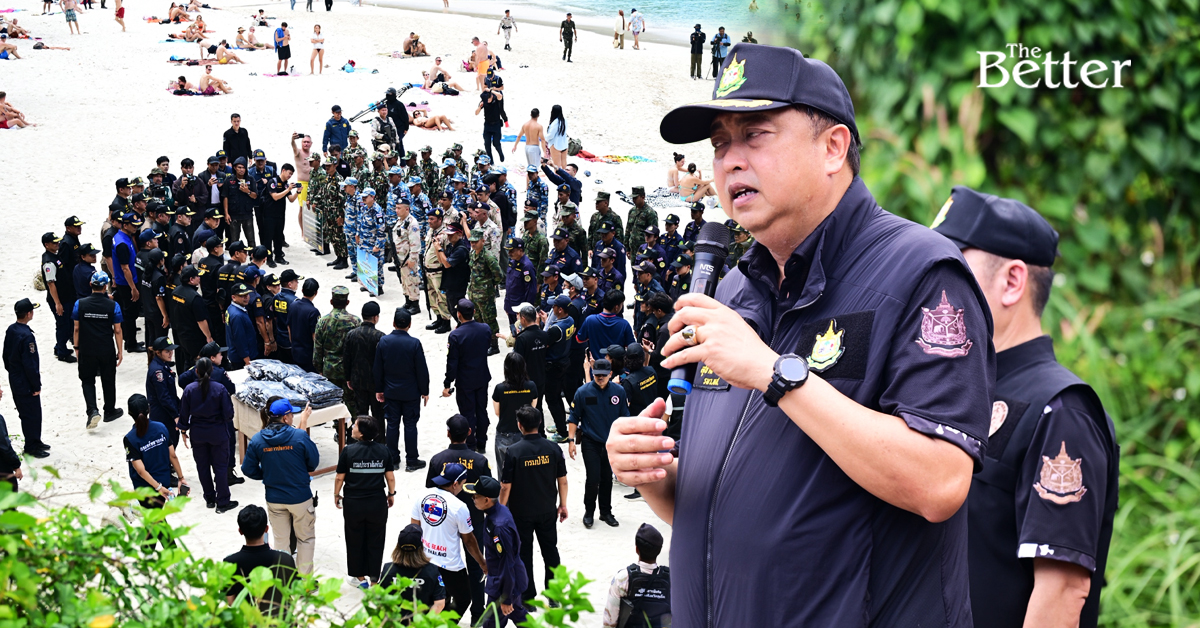
The government’s demolition campaign at Phuket’s Freedom Beach marks a high-profile attempt to reclaim encroached public land, dismantle alleged networks of local influence, and restore public access to one of the island’s most valuable natural attractions. However, the real test will be whether the authorities can turn the operation into lasting land governance reform rather than a one-off enforcement spectacle.
From beach encroachment to a national governance test
The operation, launched on November 8, 2026, mobilized personnel from the Royal Forest Department, environmental agencies, local authorities, and police to dismantle 22 structures occupying more than nine rai of land in the Nakkerd Hills National Forest Reserve in Karon. Heavy machinery and excavators were deployed to clear the structures after the authorities completed the relevant legal procedures and issued demolition orders.
The operation was conducted under the government's broader “Phuket Model”, which seeks to reclaim state-owned land from illegal occupation and prevent influential individuals or business networks from monopolizing public natural resources.
Natural Resources and Environment Minister Suchart Chomklin said the campaign followed Prime Minister Anutin Charnvirakul's directive to take decisive action against influential groups involved in encroachment on state land. He stressed that natural resources and public beaches must remain accessible to all citizens, regardless of their economic status or political connections.
“Freedom Beach must truly be a beach of freedom—a place accessible to everyone, whether they are Phuket residents, Thai citizens from other provinces, or international tourists.”
Suchart said the government's objective extended beyond demolishing buildings. The reclaimed area would be restored and managed as a recreational forest covering more than 41 rai, with plans for a visitor centre and environmentally responsible tourism facilities.
The government intends to develop the site into an A+ quality tourist destination while preserving its natural character. Suchart described the operation as a New Year gift to the Thai public, arguing that reclaiming the beach represented the restoration of public rights rather than simply the recovery of state land.
A decade-long dispute over land ownership and access
Freedom Beach's latest controversy is part of a much wider problem involving land encroachment, questionable ownership claims, and the commercialization of public spaces in Phuket.
Located along the southwestern coast of Phuket, between Patong and Karon, Freedom Beach is known for its relatively secluded setting, white sand, and forested hillsides. Its natural beauty has made it an attractive destination for international visitors, but its difficult terrain and limited road access have also created opportunities for private operators to control entry routes and commercial activities.
Investigations reported by The Phuket News indicate that alleged encroachment in the area had persisted for more than a decade. Authorities have examined claims involving questionable land documents, unauthorized construction, and the alleged imposition of entrance fees on visitors.
In March 2026, a major inspection involving more than 100 officials uncovered extensive encroachment within the Nakkerd Hills National Forest Reserve. The operation resulted in five arrests and intensified scrutiny of structures and businesses operating around the beach.
The controversy also involved allegations that visitors had been charged approximately 200–300 baht to access the beach, with operators claiming that the payments covered maintenance and waste management. Authorities subsequently investigated whether the access charges and supporting land documents had a legitimate legal basis.
In March, Phuket MP Chalermpong Saengdee called for stronger intervention by the Ministry of Natural Resources and Environment, warning that the encroachment of protected forest areas was not merely a property dispute but a threat to Phuket's environmental sustainability.
He also raised concerns about forest destruction in watershed areas, which could aggravate water shortages during the dry season. The issue is particularly significant for Phuket, an island whose tourism economy depends heavily on its natural environment and increasingly strained infrastructure.
The alleged land fraud and the economics of illegal occupation
The financial dimension of the Freedom Beach controversy is equally significant.
On November 7, police arrested a man identified as Parinthorn, known locally as “Sia Lek of Freedom Beach”, along with three family members, over allegations involving fraudulent land sales and the use of false information in a computer system.
According to Thai PBS World, investigators believe protected forest land was marketed and sold to buyers under claims that legitimate ownership documents existed. The reported transactions involved approximately 20 million baht, with buyers subsequently discovering that the land was located within a national forest reserve and could not legally be traded as private property.
All four suspects were taken for questioning and denied the allegations. The investigation is ongoing, and the charges must be determined through the judicial process.
The case illustrates a particularly damaging feature of illegal land occupation: the potential creation of an informal property market in which buyers are persuaded to purchase land that may not carry legally recognized ownership rights.
Such transactions can generate multiple layers of financial damage. Buyers risk losing their investments, the state loses control over protected land, and the surrounding environment may suffer irreversible damage from construction and land clearance.
The wider implications extend beyond Freedom Beach. Phuket's high land values and strong demand for luxury accommodation have created considerable financial incentives to exploit gaps in land administration and enforcement.
A special report by Thairath in July 2026 described how influential local networks and investors could allegedly use informal agreements, questionable land claims, and connections with public officials to establish control over beaches and forest areas. The report raised concerns that illegal occupation could become entrenched through successive transfers and commercial operations.
This raises an important question for the government: can demolishing illegal structures address the underlying networks that enable the occupation of public land, or will enforcement remain limited to removing buildings after the damage has already occurred?
The Phuket Model: A broader crackdown on state-land encroachment
Freedom Beach is not an isolated case. The government has increasingly targeted illegal occupation of protected forest areas and public beaches across Phuket, where rising property values and tourism investment have intensified competition over coastal land.
In July 2026, the Royal Forest Department ordered the removal of 22 structures at Freedom Beach under Section 25 of the National Reserved Forest Act B.E. 2507 (1964). The occupants were given until August 5 to comply before compulsory demolition.
The department said its inspections had identified forest clearing across approximately 9 rai, 1 ngan and 20 square wah. It also rejected ownership claims based on historical land documents, arguing that the documents cited by the occupant referred to a different location in Patong rather than the disputed land in Karon.
Similar enforcement action has taken place at nearby Nui Beach, where authorities ordered the removal of 39 structures occupying more than 15 rai of protected forest land. These cases suggest that the government is attempting to establish a wider enforcement precedent rather than address individual disputes in isolation.
Prime Minister Anutin previously pledged to pursue not only those occupying protected land but also any public officials suspected of facilitating illegal transactions or improperly issuing land documents.
In May 2026, Anutin said the government would investigate the alleged involvement of influential networks, including potential nominee arrangements involving Thai nationals and foreign investors. Authorities reported 23 legal cases and searches at 14 locations as part of the broader investigation.
This is an important distinction. Demolishing structures can restore physical control over state land, but dismantling the networks behind illegal occupation requires investigations into land registration, financial transactions, the possible involvement of officials, and the identities of the ultimate beneficiaries.
Without accountability across the entire chain, the same land could eventually become vulnerable to renewed encroachment.
The challenge: Public access versus commercial tourism
One particularly important aspect of the Freedom Beach case concerns how the government intends to manage the reclaimed land.
The Royal Forest Department officially designated more than 41 rai at Freedom Beach as a recreational forest in February 2025. The designation was intended to preserve the area while allowing regulated ecotourism activities and certain public services.
However, the policy also allows the possibility of commercial activities within designated service zones, including visitor facilities and the collection of entrance fees under Royal Forest Department regulations. At the time, officials said the specific business arrangements and fee structures had yet to be finalized.
This creates an important policy question: how can the government ensure that the restoration of public access does not eventually lead to another form of commercial monopolization?
The distinction between legitimate tourism management and the privatization of public natural resources must be clearly established.
A visitor centre, public toilets, waste-management facilities, and environmental protection measures could improve the beach's long-term sustainability. However, commercial concessions, access charges, and business licensing must operate under transparent regulations that prevent privileged operators from exercising exclusive control.
The government should therefore establish clear rules on public access, commercial licensing, fee collection, environmental standards, and community participation.
Local residents should also have opportunities to benefit from tourism activities without compromising the public's right to access the beach.
Environmental protection must go beyond demolition
Another challenge is ensuring that the reclamation operation produces measurable environmental improvements.
Phuket's tourism industry depends heavily on its coastal ecosystems, forests, watersheds, and beaches. Uncontrolled construction and forest clearance can undermine these assets through soil erosion, habitat destruction, wastewater pollution, and pressure on already limited water resources.
The concerns raised by Phuket MP Chalermpong Saengdee over watershed degradation and seasonal water shortages demonstrate how illegal land occupation can create consequences extending well beyond individual properties.
Consequently, restoring Freedom Beach should involve more than removing buildings and clearing access routes. Authorities should conduct environmental assessments, rehabilitate damaged vegetation, establish limits on construction, and implement long-term monitoring of the surrounding forest.
The proposed visitor centre should also function as an environmental management facility, providing information about conservation, waste disposal, visitor safety, and responsible tourism.
If implemented properly, the recreational forest designation could become a model for balancing tourism development with environmental protection.
A test of government credibility and the rule of law
The significance of the Freedom Beach operation extends beyond Phuket's tourism industry. It represents a test of whether the Thai government can enforce land and environmental laws consistently, particularly in areas where valuable property interests and influential networks may be involved.
Thailand has long faced challenges involving overlapping land documents, disputed boundaries between state and privately claimed property, inconsistent enforcement, and allegations of official complicity in illegal land transactions.
The Freedom Beach controversy highlights the economic consequences of these weaknesses. When protected land can be occupied, commercialized, or offered for sale through questionable documentation, the problem affects not only environmental conservation but also property rights, investor confidence, and the credibility of public institutions.
The government's approach must therefore combine three elements:
1. Law enforcement: Complete demolition orders, pursue criminal investigations, and hold anyone involved in illegal land occupation accountable, including public officials where evidence warrants prosecution.
2. Land administration reform: Improve land surveys, digital mapping, title verification, and coordination between forestry authorities, the Land Department, local administrations, and law enforcement agencies.
3. Sustainable management: Establish transparent rules governing public access, tourism businesses, environmental protection, and community participation in reclaimed areas.
The government should also publish regular progress reports on the investigations, demolition work, restoration budget, and subsequent management of the land. Such transparency would help demonstrate that the operation is an institutional commitment rather than a temporary political campaign.
From ‘Checkmate’ to lasting reform
The name “Checkmate: The 3-Billion-Baht Freedom Beach Operation” reflects the government's determination to end what it describes as the occupation and exploitation of valuable public land.
According to the Public Relations Department's Phuket office, the November 8 operation mobilized more than 500 personnel to remove 22 structures occupying more than nine rai, while the wider restoration plan covers more than 41 rai.
But the real value of this operation cannot be measured solely by the estimated value of the reclaimed land or the number of structures demolished.
Its success will ultimately depend on whether the government can prevent renewed encroachment, ensure equal access for the public, protect the environment, and establish a transparent system for managing valuable coastal resources.
For Phuket, where tourism development has placed increasing pressure on land and natural resources, protecting beaches is also an economic necessity. The island's long-term competitiveness depends on preserving the natural attractions that draw visitors in the first place.
Freedom Beach could therefore become a significant test case for Thailand's ability to reconcile tourism growth, environmental conservation, and the rule of law.
The ultimate checkmate will not be the demolition of 22 buildings. It will be ensuring that no individual, business network, or politically connected group can reclaim public land for private gain once the authorities have handed it back to the people.
The Better News English