
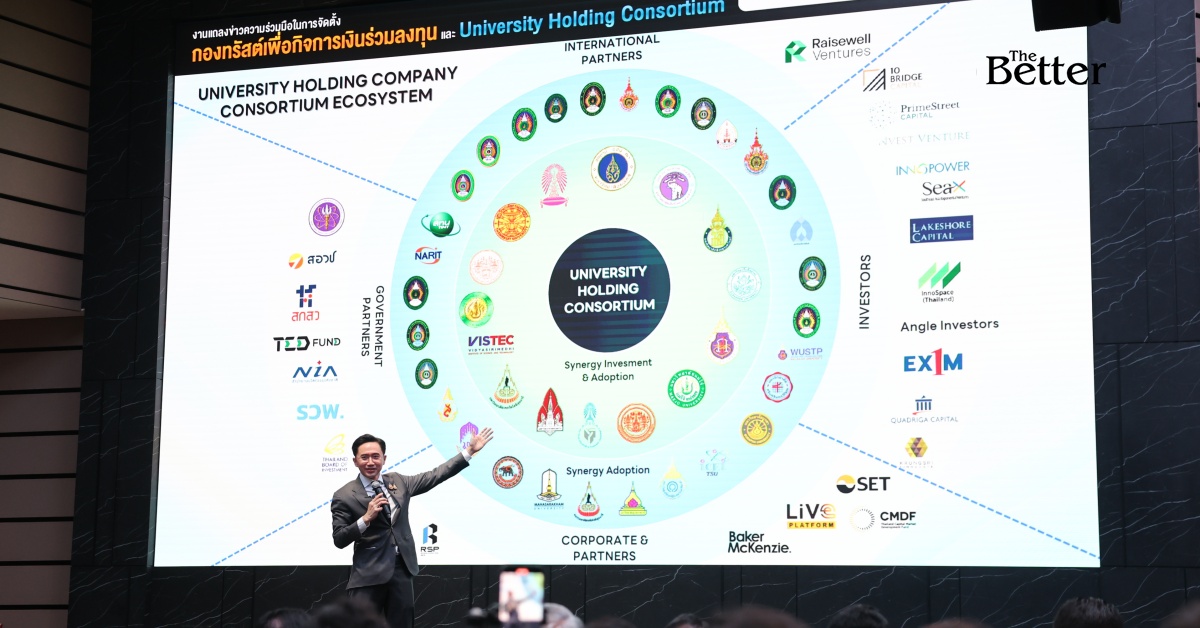
15 Thai Universities Join Forces to Launch UHC Consortium, Driving Research into Deep Tech Businesses
The Office of the National Higher Education Science Research and Innovation Policy Council (NXPO) and the National Innovation Agency (Public Organization) (NIA), under the Ministry of Higher Education, Science, Research and Innovation (MHESI), have joined forces with the Stock Exchange of Thailand (SET) and other public and private sector partners to launch the University Holding Company Consortium (UHC Consortium).
The launch ceremony was held on September 15, 2026, at the Sukree Kaewcharoen Auditorium at the Stock Exchange of Thailand and was presided over by Prof. Dr. Yotsanan Wongsawat, Deputy Prime Minister and Minister of Higher Education, Science, Research and Innovation.
The initiative brings together 15 higher education institutions and their respective university holding companies, along with public and private sector partners. By pooling capital, capabilities and business opportunities, the consortium aims to accelerate the transformation of Deep Tech research into commercial applications and viable businesses.
The consortium has set ambitious targets for 2032: the creation of 100 Deep Tech spin-off companies, five companies ready for stock market listing, and one unicorn company.
Turning Knowledge into Economic Value
Delivering a special keynote address titled “Thailand New Economy: From Knowledge to National Growth,” Prof. Dr. Yotsanan emphasized that universities are the country’s primary repositories of knowledge and research.
The key challenge, he said, is to unlock the economic value of this knowledge by identifying and developing intellectual property, followed by licensing and commercialization. Another pathway is to establish startups or spin-off companies based on university research and innovation.
Prof. Dr. Yotsanan said the UHC Consortium would strengthen the capabilities of individual university holding companies and enable them to undertake missions that might be difficult for a single university to accomplish alone.
For example, joint investment by several universities in the same company could support multi-center clinical trials and real-world technology testing. The consortium could also enable universities to jointly identify promising technologies and talent, share investment risks, and strengthen the confidence of external investors.
He added that when university holding companies invest in a technology and help bring it successfully into domestic use, the resulting track record can strengthen the credibility of the business. This, in turn, could help attract foreign investment and support expansion into international markets.
The ultimate goal is to enable Thai research-based businesses to compete globally. As these companies grow, Prof. Dr. Yotsanan said, the benefits could return to Thailand and its people through wider access to technologies at more affordable prices.
“Our objective is not merely to use Thai products to support Thailand; we must leverage Thai innovations to attract foreign capital and instill the confidence needed for international investment in the country,” said Prof. Dr. Yotsanan.
Three Programs to Build a Deep Tech Ecosystem
Asst. Prof. Dr. Thanyanuphap Anantana, Vice President of Chiang Mai University and a key driver of the collaboration, presented the consortium’s operating framework.
He said Thailand’s University Holding Company mechanism was established in 2018 and has since grown to include 15 UHCs. Although Thai universities possess significant research and technological capabilities, challenges remain in commercializing research and ensuring that spin-off companies have sufficient business and management readiness.
The consortium model is intended to address these challenges through three core programs:
1. UHC Synergy – Pooling Capital
This program aims to combine financial resources through co-investment among early-stage UHCs, both through direct investment and investment via the NIA’s holding company. The objective is to accelerate spin-offs’ access to capital, supported by mechanisms from the NIA, the Technology and Innovation-based Enterprise Development Fund (TED Fund), and the Office of Research and Innovation for Competitiveness and Area-based Development (Public Organization).
2. UHC Venture Builder – Pooling Capabilities
This program focuses on combining expertise and capabilities from different universities to jointly develop teams, technologies, business models and go-to-market strategies. It also connects participating businesses with support from the NIA, TED Fund and InnoSpace (Thailand).
3. UHC Innovation Catalyst – Pooling Opportunities
This program focuses on connecting university spin-offs with business opportunities, markets, growth and scaling opportunities, capital-market access and international partner networks. The initiative will work with organizations including the Board of Investment (BOI) and the Stock Exchange of Thailand, as well as venture capital (VC) and corporate venture capital (CVC) investors.
Building a Shared University Innovation Network
The UHC Consortium was established through the collaboration of 15 higher education institutions and their respective holding companies:
- Chulalongkorn University
- Khon Kaen University
- Kasetsart University
- Chiang Mai University
- Thaksin University
- King Mongkut’s University of Technology Thonburi
- Suranaree University of Technology
- Thammasat University
- Maejo University
- Mahidol University
- Walailak University
- Silpakorn University
- Prince of Songkla University
- King Mongkut’s Institute of Technology Ladkrabang
- Vidyasirimedhi Institute of Science and Technology
The initiative seeks to combine the individual strengths of these institutions into shared network resources, including research and intellectual property, personnel and expertise, laboratories and infrastructure, and industry networks.
The consortium builds on the University Holding Company mechanism, a model that has been continuously promoted by NXPO. Its development was further supported by the 2023 Prime Minister’s Office Regulation on Public-Private Joint Investment in Projects Utilizing Research and Innovation Outcomes, which was introduced to address constraints and clarify the legal framework governing joint investment.
The regulation has helped pave the way for universities to move beyond operating individual UHCs toward a more collaborative consortium model capable of mobilizing resources and investment across institutions.
B1-Baht PE Trust to Support New Economy Businesses
At the same event, the Stock Exchange of Thailand, the Capital Market Development Fund (CMDF), the National Innovation Agency and other public and private sector partners also announced the establishment of a Private Equity Trust (PE Trust) with an initial value of 1 billion baht.
The fund will focus on New Economy businesses, particularly those operating in Deep Tech, digital technology and artificial intelligence (AI), medical and health technologies, as well as future agricultural and food technologies.
The PE Trust is intended to provide another financing mechanism to help bridge the funding gap faced by innovative businesses, enabling them to scale their operations, strengthen their competitiveness and eventually access the capital market.
Through the combination of university research, pooled investment, shared capabilities and access to domestic and international markets, the UHC Consortium aims to create a stronger pathway for Thai innovations to move from laboratories and intellectual property into commercially viable businesses and, ultimately, global markets.
The Better News English